Can Someone Find My Friends | Donate Your Voice - Ad Analysis

AI Editor notes
Straight from the gut!!
“Cause campaigns that crowdsource user singing usually risk feeling gimmicky, but this cuts straight to the bone. Rooting the film in Sonita's authentic trauma before building to the wall of donated voices earns its emotional scale. It turns what could have been slacktivism into genuine global solidarity.”
Quick Summary
The campaign transforms a digital participatory action—donating one's voice via social media—into an emotive anthem that breaks the enforced silence on Afghan women.
Executive Summary
The Core Insight: When an oppressive regime enacts laws forbidding women from speaking or singing in public, silence is no longer just absence of noise; it becomes a weapon of erasure. The human truth at the core of 'Can Someone Find My Friends' is that those who possess freedom of speech bear an ethical obligation to lend their voice to those who have been stripped of theirs.
The Execution: Using a classic Problem–Solution–Proof narrative structure, the film begins with intimate, personal confrontation. In the problem stage (0:00–1:47), director Jean-Charles Charavin introduces archival photos of Sonita Alizadeh's youth before placing her in a dust-choked, decrepit classroom. As she sings about losing her childhood friends to child marriage and conflict, the young students around her sit frozen, their notebooks filled with silent pleas. Sonita's lead vocal carries the full weight of survivor's guilt and isolation.
The turn and solution stage (1:48–2:20) strips the narrative down to raw performance. Stepping onto an empty soundstage, Sonita sheds her head covering and sings directly into the dark void. This transition exposes the vulnerability of a solitary activist carrying an unbearable burden.
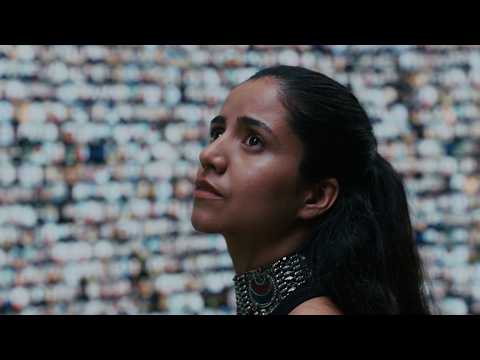
The proof stage arrives at 2:21 when a towering 360-degree curved LED screen illuminates behind her. Hundreds of everyday citizens from around the world appear in vertical video tiles—singing along to her chorus under the 'Donate Your Voice' social filter. Produced by John Foyle, the audio layers these global TikTok submissions into a sweeping, unified choir that backs Sonita's voice, turning her personal plea into an unstoppable collective movement.
The Debrief: Social impact campaigns frequently struggle to convert passive awareness into active participation. By designing the creative artifact around the literal aggregation of public contributions, Publicis Conseil demonstrated how crowdsourced content can serve as both the distribution engine and the emotional climax of a brand's narrative.
Theme Keywords
Brand Position
The global voice and protective shield for vulnerable youth and women in crisis zones.
Brand Archetype
The Caregiver and The Rebel; Empathetic, Defiant, Mobilizing.
Creative Game Plan
Turn a restrictive decree silencing Afghan women into an international movement where global citizens donate their vocal tracks to complete Sonita's anthem.
Diagnosis: Issues & Solutions
Primary Issue: Clarity of "What's Next?"
The Problem:
The closing card limits its ask to 'Raise your voice for the women who have been silenced by sharing the video,' omitting a prominent web link or QR code directing traffic to UNICEF's operational relief programs and policy petitions.
The Solution:
Pair the social share callout with a clear on-screen URL and QR code linking directly to the UNICEF Afghanistan relief fund and policy action center.
Secondary Issue: Strategic Sense
The Problem:
The transition from the cinematic classroom metaphor to vertical TikTok frames creates a slight aesthetic friction between documentary solemnity and social media mechanics.
The Solution:
Introduce brief subtle audio cues or transitional framing earlier in the film to contextualize the incoming user voices before the full digital reveal.
Additional Notes
Credits
Share this Analysis
More UNICEF ad breakdowns
- Watch what happens when parents join children to play | UNICEFUNICEF
- UNICEF 'Granatapfel'UNICEF
- Violence marks forever - Join David Beckham and end violence against childrenUNICEF
- Adrenaline ExperimentUNICEF
- These parrots will make you say WTF | UNICEFUNICEF
- #NoLostGeneration, Some stories were never meant for childrenUNICEF
- Millie Bobby Brown: Go Blue on World Children’s Day | UNICEFUNICEF
- The Greatest Story - The Good Guys Christmas - Eng - Unicef SwedenUNICEF