Domund - He - Ad Analysis

AI Editor notes
Straight from the gut!!
“This is a clever piece of emotional manipulation for a good cause. The 'gotcha' social experiment format feels a little dated now, but for its time, this was sharp. It makes you lean in, then punches you with the reveal. My first thought was, 'Would I have seen him?' It effectively weaponizes a celebrity's fame by first making him anonymous. It's a smart way to make an old problem feel immediate.”
Quick Summary
This ad's power comes from a single, jarring moment: the reveal. By using a famous actor disguised as a homeless person, it transforms the abstract problem of social apathy into a concrete, personal shock. It forces viewers to confront the uncomfortable truth that they are conditioned to ignore people in need, making the subsequent appeal for donations feel both urgent and necessary.
Executive Summary
This Domund campaign is a textbook example of the 'social experiment' as a creative device, executed with disciplined focus. Its success hinges on a simple, powerful human insight: in our busy lives, we develop a form of selective sight, rendering the people who most need our help invisible. The ad doesn't just state this; it proves it in a way that is both compelling and personally convicting.
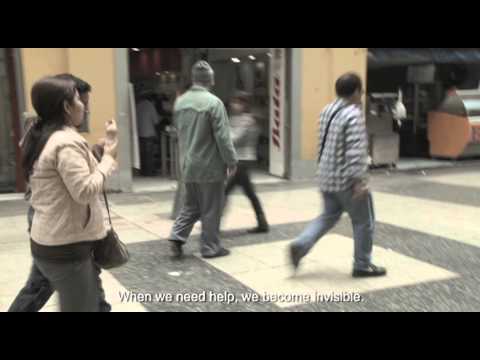
The execution follows a classic Setup-Turn-Payoff structure. The Setup (0:00-0:20) meticulously establishes the premise. Through a series of vignettes shot with a documentary-style realism, we see a man in need being completely ignored. The desaturated color palette and somber piano score create a feeling of isolation and melancholy. The viewer is led to believe this is a standard, if well-produced, charity appeal showing the plight of the homeless. The repetition of him being ignored builds a quiet tension and reinforces the core problem.
The Turn (0:21-0:31) is the ad's strategic centerpiece. The voiceover explicitly states the theme—"When we need help, we become invisible"—just as the subject stops, faces the camera, and removes his beanie. The reveal that the 'invisible' man is Renzo Schuller, a famous Peruvian media personality, is a sharp, effective twist. It shatters the viewer's passive observation and creates a moment of cognitive dissonance. The audience is forced to ask themselves, 'If I wouldn't have noticed a celebrity, who else am I not seeing?' This transforms the ad from a story about 'them' to a question about 'me'.
The Payoff (0:32-0:41) provides the resolution to the discomfort the ad has created. The line, "Let's take a look again," is a direct challenge to the audience to change their perspective. The final call to action for the Domund collection on specific dates is the crucial final piece. It channels the guilt, surprise, and newfound awareness into a simple, tangible action. The ad doesn't just make you feel bad; it gives you an immediate opportunity to do good.
What the team should learn from this is the power of a reveal to reframe a familiar problem. Instead of relying on traditional, often-ignored images of poverty, the campaign created a psychological hook. It used a celebrity not just as an endorsement, but as a narrative tool to make the message of invisibility unforgettably visible.
Theme Keywords
Brand Position
The official, trusted channel for transforming passive empathy for the 'invisible' people in society into tangible, impactful action.
Brand Archetype
Caregiver
Creative Game Plan
Prove that anyone, even a famous person, becomes invisible when they appear to be in need, thereby forcing the audience to confront their own indifference.
Diagnosis: Issues & Solutions
Primary Issue: Clarity of "What's Next?"
The Problem:
The ad masterfully illustrates the problem of social invisibility but doesn't explicitly connect why Domund is the specific solution. The viewer understands the need to help, but not necessarily why this particular organization is the best vehicle for that help beyond being the one asking.
The Solution:
Strengthen the link between the problem and the brand's unique solution. A simple change to the final tagline, such as 'DOMUND. We make sure they are seen. Help in the most difficult places,' would close the strategic loop and reinforce the brand's purpose.
Secondary Issue: Emotional Connection
The Problem:
The cleverness of the celebrity reveal risks creating a feeling of a 'trick' rather than a moment of genuine emotional connection. The viewer might remember the stunt more than the underlying human issue.
The Solution:
To ground the emotion, a brief shot of Renzo Schuller looking genuinely saddened or affected by the experience *while in disguise* could have been included before the reveal, making his participation feel less like a performance and more like a personal testimony.
Additional Notes
Credits
Share this Analysis
More Domund ad breakdowns
- Domund HungerDomund
- Deadpool and Kidpool Help SickKidsSickKids Foundation
- We Can Save Them #shinealightHuman Appeal
- The Fading Symphony with Tim MinchinMND Australia
- Seeing is Easy TV Ad- Guide Dogs NSW/ACTGuide Dogs NSW/ACT
- Rock the Ribbon - World AIDS Day 2018National AIDS Trust
- Joy to the WorldThe Salvation Army