Urban Company | Salon at Home - Ad Analysis

AI Editor notes
Straight from the gut!!
“It's a straightforward, almost formulaic, celebrity spot. The comparison device is as old as advertising itself. It works, it's clear, but it's completely forgettable. The claim of being 'India's most innovative' feels like a stretch when the examples shown—facial steamers and hair stylers—are standard equipment. It’s a functional ad that does a job, but it has zero creative flair or lasting brand-building power.”
Quick Summary
This ad uses celebrity Kriti Sanon to directly challenge the traditional salon model, positioning Urban Company's at-home service not merely as a convenience, but as a technologically superior and more innovative beauty experience. The entire strategy hinges on creating a clear distinction: 'regular salons' are old news, while Urban Company is the future.
Executive Summary
Urban Company's 'Salon at Home' spot is a textbook example of a challenger brand using a celebrity to establish a new norm. The entire ad is built on a simple, direct comparison intended to reframe the consumer's choice—it’s not about which salon to go to, but whether to go to a salon at all.
The Core Insight: The ad taps into a potent consumer insight: modern, urban women value convenience but are unwilling to compromise on the quality or trendiness of their beauty treatments. They fear that 'at-home' might mean 'amateur.' The ad’s job is to dismantle this fear by positioning the at-home option as the more advanced, professional choice.
The Execution (Comparison Framework): The ad follows a classic comparison narrative structure, executed with speed and efficiency in its 26-second runtime.
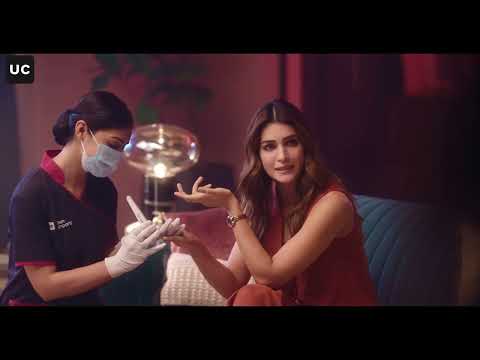
- The Setup: It opens with a skeptical friend asking Kriti Sanon, the celebrity anchor, why she chose Urban Company over her 'regular salon'. This question verbalizes the audience's potential hesitation and immediately frames the ad as a direct comparison.
- The Turn: Kriti's response, 'How can you compare?', immediately elevates Urban Company out of the traditional category. She makes the bold claim that 'UC deta hai India ka sabse innovative salon experience' ('UC gives India's most innovative salon experience'), setting up the need for proof.
- The Proof: The ad delivers this proof through a quick-cut montage. We see 'advanced facial tools,' 'heatless hair styling,' and a 'trendy nail studio.' These visuals act as tangible reasons-to-believe. Whether these are truly 'innovative' is debatable, but for the ad's purpose, they serve to signify a professional, well-equipped service that goes beyond basic expectations.
- The Payoff: The payoff is twofold. First, the skeptical friend is shown convinced and happy, providing social proof. Second, Kriti delivers a clear call-to-action, holding up the app and inviting viewers to 'get the beauty experience you deserve.' This final line cleverly ties the 'innovation' back to a feeling of self-worth and empowerment.
The Debrief: The team behind this ad successfully created a clear, functional, and persuasive piece of communication. It's a solid example of performance-oriented creative, designed to overcome a specific consumer barrier (quality perception) and drive app downloads/bookings. However, the reliance on a simple celebrity comparison and slightly exaggerated claims of 'innovation' gives the ad a short shelf life. It does the job of explaining the 'what' and 'why' but fails to build a deeper emotional connection that could lead to long-term brand loyalty over category leadership.
Theme Keywords
Brand Position
The smarter, more innovative, and professional salon that comes to you.
Brand Archetype
The Sage (offering a wiser, more innovative solution) with hints of the Magician (transforming your home into a salon).
Creative Game Plan
Use a major celebrity to directly discredit the traditional salon experience by framing our at-home service as more modern and innovative.
Diagnosis: Issues & Solutions
Primary Issue: Emotional Connection
The Problem:
The ad is entirely functional and rational, focusing on tools and services. It shows the 'how' but misses the 'why' on an emotional level. The key feeling of being pampered, relaxed, and confident after a great salon experience is told, not felt by the viewer.
The Solution:
Shift focus from the tools to the feeling. Instead of just showing a facial steamer, show the serene, blissful expression on Kriti's face. Show her looking confidently in a mirror after her 'heatless styling,' capturing the end benefit, not just the process.
Secondary Issue: Strategic Sense
The Problem:
The claim of being 'India's most innovative salon experience' rests on features (facial steamers, nail art kits) that are table stakes in most decent, modern salons. This makes the core claim feel slightly hollow and vulnerable to being easily matched or dismissed by consumers familiar with good salons.
The Solution:
Ground the innovation claim in something more ownable and less tangible than just equipment. Focus on the data-driven personalization, the highly-vetted professionals, or the seamless app experience as the true innovation, rather than just the tools they bring.
Additional Notes
Related Links
Credits
Share this Analysis
More Urban Company ad breakdowns
- Chhota Kaam? | Urban CompanyUrban Company
- Chhoti Baat? | Urban CompanyUrban Company
- AC hai ya Pankha? | Foamjet AC Servicing | Urban CompanyUrban Company
- Regular Cleaning vs Shine Waali Cleaning | Professional Cleaning | Urban CompanyUrban Company
- Chhoti Soch? | Urban CompanyUrban Company
- Mrs Saini Ka Bathroom Kitna Shiny | Professional Cleaning | Urban CompanyUrban Company
- Professional Cleaning | Tamil | Puthandu | Urban CompanyUrban Company
- Safety | Hindi | Salon for Men | Urban CompanyUrban Company