Euphejisms - Get Your Prostate Checked - Ad Analysis

AI Editor notes
Straight from the gut!!
“This is a long walk for a short drink of water, but the walk is so damn entertaining you don't mind. The deadpan delivery against the Wes Anderson-esque visuals is perfect. It's smart because it doesn't lecture or scare you. It treats the viewer with intelligence, using wit to smuggle in a genuinely important message. It’s the opposite of a boring PSA, and that's why it works.”
Quick Summary
This campaign brilliantly hijacks the awkwardness of talking about men's health by diverting it to something even more awkward: creating a dictionary of slang for semen. It uses high-brow humor to disarm the viewer, making an uncomfortable topic (prostate checks) feel approachable, memorable, and shareable.
Executive Summary
The core challenge for any public service announcement, especially one concerning men's health, is overcoming apathy and awkwardness. The 'Euphejisms' campaign doesn't just acknowledge this awkwardness; it weaponizes it. The central insight is that men have created a rich, if ridiculous, vernacular to deal with one aspect of their reproductive life (semen) while utterly neglecting the mechanical source that makes it possible (the prostate). By confronting this hypocrisy through humor, the ad effectively dismantles the stigma that prevents men from seeking medical advice.
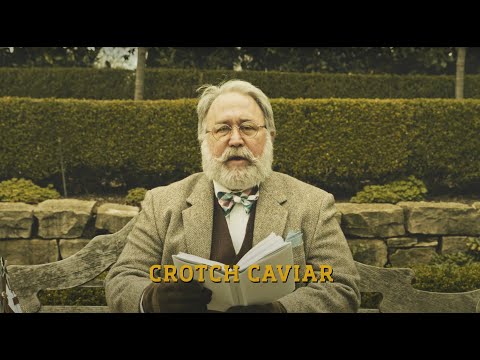
The execution follows a classic Hook-Value-Proof-Ask structure, stretched over a patient two-and-a-half minutes. The hook is purely atmospheric: a dapper, scholarly man in a hyper-manicured garden, creating immediate visual intrigue. The value, and the engine of the film, is the comedy. The deadpan recital of absurd, invented slang like 'Crotch Caviar' and 'Albino Guacamole' provides the entertainment that keeps the audience engaged. The humor is derived from the stark contrast between the sophisticated, almost poetic presentation and the crass subject matter. The crucial pivot, or 'the turn,' arrives with the line, 'Whatever you call it, the prostate makes it possible.' This is the 'Proof' that connects the comedic journey to its serious destination. It reframes the entire preceding montage, transforming it from a silly joke into a relevant health message. The 'Ask' is twofold: the primary behavioral call-to-action is 'Get yours checked,' followed by a secondary fundraising CTA to 'buy the book.'
The debrief for the creative team would be a lesson in the power of misdirection. They proved that for a sensitive topic, the most effective route isn't always the most direct one. Instead of leading with fear or dry statistics, they built a world, told a joke, and earned the audience's attention. The key takeaway is that by creating a piece of entertainment first and a PSA second, they made something people would choose to watch and share, extending the campaign's reach far beyond what a typical health message could achieve. The strategy relies on the intelligence of its audience to connect the dots, and in doing so, it treats them as partners in the conversation rather than pupils in a lecture.
Theme Keywords
Brand Position
The witty, intelligent way to have uncomfortable but essential conversations about men's health.
Brand Archetype
The Jester
Creative Game Plan
Use high-brow, deadpan comedy to neutralize the stigma around a low-brow, uncomfortable health topic.
Diagnosis: Issues & Solutions
Primary Issue: Strategic Sense
The Problem:
The 2:31 runtime is a significant barrier in a digital environment optimized for short-form content. It limits the ad's utility in paid media placements and relies almost entirely on organic sharing and PR to find its audience.
The Solution:
Develop a suite of shorter :15 and :30-second cutdowns. Each short ad could feature 2-3 of the most memorable euphemisms, delivering the punchline and CTA much faster, making the campaign scalable across a wider range of platforms like pre-roll and social feeds.
Secondary Issue: Clarity of "What's Next?"
The Problem:
The dual call-to-action—'Get checked' and 'Buy the book'—while logical, can dilute the urgency of the primary health directive. Viewers may remember the clever book concept more vividly than the crucial, and less novel, instruction to see a doctor.
The Solution:
Revise the final graphic to more explicitly link the two actions. For instance: 'Buy the book to help the cause. Book a check-up to help yourself.' This frames them as complementary actions, strengthening the core message rather than potentially competing with it.
Additional Notes
Credits
Share this Analysis
More Euphejisms ad breakdowns
- Pick Up Your PoopFuck Cancer
- For Your Breast SafetyPink Train (Roza Vilciens)
- Purple September 2018 - Cystic Fibrosis Awareness MonthInstituto Unidos pela Vida
- Fondation Recherche Cardio Vasculaire - Institut de France - "Nathalie" VAFondation Recherche Cardio-Vasculaire
- Rhian Touches Herself HDMale Cancer Awareness Campaign (MCAC)