Write A Winning Essay | Better Grades With Grammarly - Ad Analysis

AI Editor notes
Straight from the gut!!
“This is a long, feature-heavy demo disguised as a quirky, stylized ad. The Wes Anderson-inspired aesthetic is visually engaging, but at over two minutes, it feels more like an explainer video than a commercial. It's trying to be both a charming brand piece and a hard-working product tutorial, and it doesn't fully succeed at being either. The final line about 'how do you feel?' feels like a forced attempt at profundity.”
Quick Summary
This ad's primary job is to reframe Grammarly from a simple grammar checker into an indispensable, all-in-one AI writing partner for students. It achieves this by methodically walking through the entire essay-writing process—ideation, revision, and citation—and demonstrating how its new features solve specific, high-anxiety problems at each step, justifying its place as a necessary tool for academic success.
Executive Summary
This Grammarly ad is less a piece of storytelling and more a meticulously constructed argument. Its core job is to redefine the brand in the age of generative AI, moving its perceived value from a simple proofreader to an essential, end-to-end writing partner. The central insight is sharp: for students, writing isn't one task but a series of distinct, stressful hurdles. The anxiety of the blank page (ideation), the struggle for clarity (revision), and the tediousness of academic formatting (citation) are universal pain points.
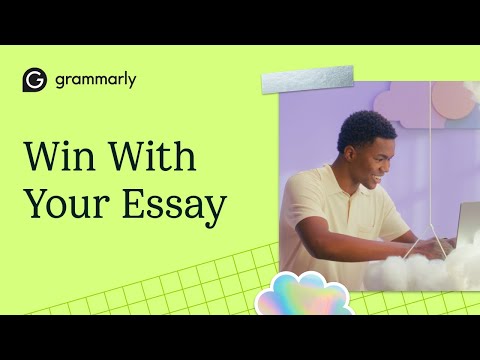
The execution uses a 'Problem-Solution' framework, visually manifested as a journey. The setup establishes the protagonist, James, overwhelmed by his thesis—a relatable starting point for the target audience. The ad then physically transports him through three stylized 'stations,' each representing a stage of the writing process. This is a clever device; it externalizes the internal mental struggle and allows Grammarly to position itself as the guide. The 'Ideation Station,' 'Revision Division,' and 'Citation Creation' are not just clever names; they are purpose-built environments that showcase a specific feature solving a specific problem. The visual style, with its distinct color palettes and symmetrical compositions, gives the demo a premium, organized feel that mirrors the product's promise of bringing order to chaos.
The turn in each micro-narrative is the introduction of the Grammarly UI, personified by a calm, authoritative voiceover. This is where the ad functions as a direct product demo, showing the 'Improve it' prompt, AI suggestions, and citation generator in action. The payoff is twofold: on a micro level, James expresses relief and confidence at each stage ('Awesome!', 'Perfect!'). On a macro level, the payoff is the submitted thesis and the 'A+' on the wall, directly linking the use of the tool to the ultimate desired outcome: academic success and validation.
From a debrief perspective, the team successfully addressed a major strategic challenge: proving its relevance against a wave of new, specialized AI tools. By also including a feature to cite AI assistance, Grammarly cleverly positions itself as a tool for academic integrity, not a shortcut for cheating—a critical message for its educational audience. The ad's main weakness is its length and lack of emotional depth. It's a rational appeal, not an emotional one. While effective for its intended purpose on platforms like YouTube, its utility as a broader, top-of-funnel brand-building asset is limited.
Theme Keywords
Brand Position
The indispensable, all-in-one AI partner for effective, confident, and responsible communication.
Brand Archetype
Sage
Creative Game Plan
Visually guide a student through a stylized journey of the writing process, using distinct 'stations' to demonstrate how Grammarly's new AI features solve every major pain point from start to finish.
Diagnosis: Issues & Solutions
Primary Issue: Emotional Connection
The Problem:
The ad is aesthetically pleasing but emotionally cold. It tells us the student feels relief and pride, but the highly stylized execution creates a distance that prevents the audience from truly feeling it with him. The final A+ and smile feel like a logical endpoint, not an earned emotional climax.
The Solution:
Connect the academic achievement to a tangible, human outcome. After he submits the paper, show him closing the laptop and immediately calling his visibly proud parents, or meeting friends for a celebratory drink. Show that the 'A+' isn't the reward; the freedom and connection it enables is.
Secondary Issue: Strategic Sense
The Problem:
At 2 minutes and 23 seconds, the ad is a significant time investment for a viewer. It tries to demo everything at once, which might cause tune-out among audiences who only have one of the specific problems being addressed.
The Solution:
Create a series of 15- and 30-second cutdowns, each focusing on a single 'station.' A short ad about beating writer's block for 'Ideation,' another for 'Revision,' and a third for 'Citations.' This allows for more targeted, platform-specific media buying and respects varying audience attention spans.
Additional Notes
Credits
Share this Analysis
More Grammarly ad breakdowns
- Save Hours a Day With GrammarlyGrammarly
- Communicate Effectively Every Time | Do Your best Work With GrammarlyGrammarly
- Blow Your Workload Out of the Water | Find Your Flow With GrammarlyGrammarly
- Get IT-Approved AI for your Team | Grammarly for BusinessGrammarly
- Words That Work | Communicate Clearly With GrammarlyGrammarly
- Write With Clarity and Confidence | Do Your Best Work With GrammarlyGrammarly
- Write in a Few Clicks, Not a Few Hours | Grammarly for BusinessGrammarly
- Get Out of Deep Water | Write Better, Faster, and Clearer With GrammarlyGrammarly