Uber Eats presents Money Can Buy You Class | Uber Eats - Ad Analysis

AI Editor notes
Straight from the gut!!
“This is smart, targeted, and genuinely funny—if you're in on the joke. Using the Countess's campy classic is a perfect cultural shortcut for a very specific audience. It feels less like a massive broadcast play and more like a surgical strike on the social feeds of Bravo fans. It's a solid piece of work that knows exactly who it's for.”
Quick Summary
Uber Eats is using niche celebrity culture to land a simple, seasonal message: the service has expanded beyond food and is now the easiest way to avoid the social embarrassment of showing up to a holiday party empty-handed. It's a clever strategic pivot from 'food delivery' to 'last-minute social salvation'.
Executive Summary
Uber Eats' 'Money Can Buy You Class' is a sharp example of how to leverage niche celebrity and cultural in-jokes to execute a precise business strategy. The core objective isn't just to entertain; it's to re-frame Uber Eats in the consumer's mind from a restaurant delivery service to a broader on-demand retail solution, specifically for the high-stakes holiday season.
The Core Insight: The simple human truth at the heart of this campaign is the social anxiety of being a bad guest. During the hectic holidays, everyone feels the pressure to show up to gatherings with a thoughtful gift, but procrastination and busy schedules often get in the way. Arriving empty-handed feels 'uncool', a minor but potent social failure. Uber Eats positions itself not as a product, but as the antidote to this very specific, relatable modern problem.
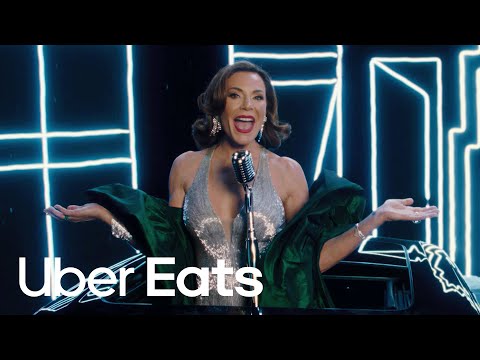
The Execution: The ad uses a classic Hook-Value-Proof-Ask structure, wrapped in the guise of a music video. The Hook is immediate and powerful for its target demographic: the opening bars of Luann de Lesseps's iconic song and her campy, glamorous presence. This instantly signals the tone and grabs the attention of any 'Real Housewives' fan. The Value proposition is delivered directly by the Countess: avoid the faux pas of showing up empty-handed. The ad frames the problem ('honey, you're not enough') and the solution ('keep it classy'). The Proof comes in the form of tangible items—flowers, chocolates, champagne, even a gift card for 'what's her name in Brooklyn'—that are shown as available through an Uber Eats delivery. This visually grounds the service's expanded offerings. The Ask is simple and direct, delivered on the final card: 'Get your last minute gifts delivered on Uber Eats.' It's a straightforward command that summarizes the ad's purpose.
The Debrief: The key takeaway is the power of surgical cultural relevance. Instead of a generic holiday ad, Uber Eats and its agency, TBWA\Chiat\Day, chose a cultural artifact with a built-in, passionate audience. [1] This ensures high engagement and shareability within that demographic. The campaign demonstrates that a brand doesn't always need to speak to everyone to be effective; sometimes, speaking directly and authentically to a specific 'someone' yields better results. It also serves as a strong case study in evolving a brand platform—moving from the general 'get anything' concept to a specific, seasonal 'get holiday gifts' proof point.
Theme Keywords
Brand Position
The effortlessly classy solution for modern social obligations.
Brand Archetype
The Jester
Creative Game Plan
Leverage a cult-classic reality TV song and its star to humorously reposition the brand's service for a specific holiday need.
Diagnosis: Issues & Solutions
Primary Issue: Strategic Sense
The Problem:
The ad's greatest strength—its reliance on niche celebrity culture—is also its primary limitation. Its humor and references are largely inaccessible to audiences unfamiliar with 'The Real Housewives', potentially limiting its impact and making it feel alienating to a broader consumer base.
The Solution:
Complement this highly targeted social execution with a broader-appeal holiday campaign for channels like broadcast TV. This allows the brand to achieve deep engagement with a core demographic while still running air cover with a more universally understood message.
Secondary Issue: Clarity of "What's Next?"
The Problem:
The final call to action is a static title card. After an energetic and engaging video, this ending feels passive and misses an opportunity to drive immediate action.
The Solution:
Incorporate a stronger, more direct call-to-action in the final seconds. This could be a voiceover from Luann saying, 'Open the app, darling,' or a quick animated graphic showing the user interface to make the next step feel more tangible and urgent.
Additional Notes
Credits
Share this Analysis
More Uber Eats ad breakdowns
- Uber Eats Super Bowl Commercial (2025) Featuring Matthew McConaugheyUber Eats
- Helen’s Golden Voice | Uber EatsUber Eats
- Don't Let Halloween Sneak Up On You | Uber EatsUber Eats
- Wine | Uber EatsUber Eats
- ゆったり楽しみたいなら、Uber Eats で、いーんじゃない? リス篇 | Uber EatsUber Eats
- When you've done enough, Uber Eats | Uber EatsUber Eats
- Period Romance - Get Almost Almost Anything | Uber EatsUber Eats
- Witches, Sandwiches - Get Almost Almost Anything | Uber EatsUber Eats