Time To Wake Up | Bobby Explains "Kya Hota Hai Mard" | Beardo X Bobby Deol - Ad Analysis

AI Editor notes
Straight from the gut!!
“So we're going all-in on the 'alpha male' archetype, are we? It's slick, no doubt, and casting Bobby Deol right now is a smart move. But the whole speech feels like it was written a decade ago. Is this meant to start a conversation, or just preach to the choir? The line 'masculinity is not a sin, it's a responsibility' feels like a direct clapback at progressive critiques. It’s bold, but I wonder if it’s building a loyal tribe at the cost of alienating a much larger audience.”
Quick Summary
Beardo leverages the cultural moment of Bobby Deol's revitalized, hyper-masculine on-screen persona to deliver an unapologetic manifesto on traditional manhood. The ad defines masculinity through stoicism, strength, and responsibility, positioning Beardo not just as a grooming product, but as the philosophical badge for men who subscribe to this ideal.
Executive Summary
This Beardo film is less of an advertisement and more of a cultural statement—a manifesto for a specific vision of masculinity. It's a confident, unapologetic piece of brand building that understands its audience intimately and chooses to speak directly to them, even at the risk of alienating others.
The Core Insight: The simple human truth at the heart of this ad is that in a world of evolving gender roles and frequent critiques of 'toxic masculinity,' a segment of men feels that traditional masculine virtues—stoicism, resilience, and a sense of duty—are being devalued. These men aren't looking for permission, but for validation. They crave a voice that tells them their inherent nature is not a 'sin,' but a 'responsibility.' Beardo steps in to be that voice, positioning itself as the champion of this unapologetic manhood.
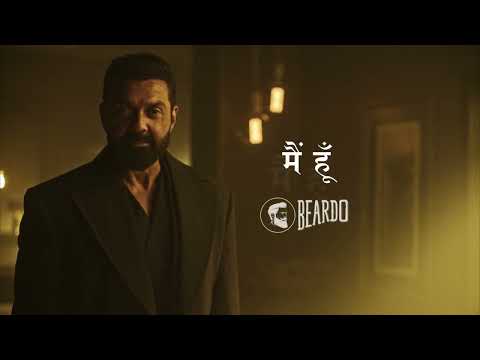
The Execution: The ad is structured as an aspirational monologue, a modern-day sermon on masculinity delivered by its current high priest, Bobby Deol. It forgoes a traditional narrative in favor of a powerful, poetic declaration. The execution follows a clear pattern of Hook–Value–Ask. The Hook is immediate and arresting: Bobby Deol's intense gaze and the provocative question, "What does it mean to be a man?" This grabs the attention of its intended audience instantly. The Value is delivered through a montage of symbolic vignettes that define the Beardo man. He's not just a person; he's an archetype built from metaphors: he 'bears wounds but doesn't show pain,' he is 'a fire that refuses to be extinguished,' and he carries the 'legacy of being a man.' The visuals reinforce this, with heavy symbols of power like lions, swords, and fire. The final Ask isn't to buy a product, but to adopt an identity. The climax—"Thump your chest and say: I am"—is a call to self-affirmation, which is then brilliantly fused with the brand in the final shot: "Main Hoon. Beardo." (I am. Beardo).
The Debrief: The key takeaway from this campaign is the power of taking a definitive stance. In a crowded market, playing it safe can make a brand invisible. By adopting a polarizing position, Beardo becomes hyper-relevant to its core demographic. The choice of Bobby Deol, fresh off a role that made him a cultural icon of hyper-masculinity, is a masterstroke in celebrity casting, ensuring the message lands with authenticity and power. The campaign proves that for a challenger brand, a passionate niche can be more valuable than a passive majority. However, the team must also recognize that this strategy inherently limits the brand's potential reach and may require a different approach if the goal ever shifts to mass-market leadership.
Theme Keywords
Brand Position
Beardo is the definitive brand for men who embrace an unapologetic, strong, and responsible form of masculinity.
Brand Archetype
The Ruler
Creative Game Plan
Fuse Bobby Deol's culturally-reverberating, intense on-screen persona with the brand's core ethos to create a definitive, modern manifesto for traditional manhood.
Diagnosis: Issues & Solutions
Primary Issue: Emotional Connection
The Problem:
The ad's tone is one of relentless intensity and power. While this resonates with the 'alpha' ideal, it lacks any warmth or vulnerability, portraying a masculinity that is solitary and almost burdensome. It preaches responsibility but doesn't show the positive impact of that responsibility on others.
The Solution:
In a future execution, introduce a single shot that adds a layer of humanity. Show the 'Beardo man' using his strength to protect or care for someone—a child, a parent, a partner. This wouldn't dilute the message of strength but would ground it in relatable, positive emotion, making the archetype more aspirational and less intimidating.
Secondary Issue: Clarity of "What's Next?"
The Problem:
The ad does a powerful job of selling an identity but fails to connect it to a tangible product. The viewer is left hyped up with a new sense of self but with no clear path to express it through the brand. It leaves the final, crucial commercial connection to chance.
The Solution:
After the final "Main Hoon Beardo" title card, add a 2-second product shot. A beautifully lit hero product (a fragrance bottle, a beard oil) with a simple super: 'Your Armor.' This would seamlessly bridge the gap between the abstract ideal and the concrete action of making a purchase.
Additional Notes
Related Links
Credits
Share this Analysis
More Beardo ad breakdowns
- Redefining Grooming For Modern Man | Evolution Theory | Hrithik Roshan | BeardoBeardo
- Kya Hota Hai Mard | Bobby Deol Raises A Question | Beardo X BobbyBeardo
- This Rakhi, Choose a Gift That Stays | The Man CompanyThe Man Company
- Smell Like a Footballman | Old Spice NFL CollectionOld Spice
- Promoting positive role models off the court | Dove Men+CareDove Men+Care
- NIVEA MEN & LIVERPOOL FC | ‘Never Alone’NIVEA MEN
- The Duke Cannon Un-NIL DealDuke Cannon Supply Co.
- Welcome to the ClubDollar Shave Club