The Chase is On – Round of 16 - Ad Analysis

AI Editor notes
Straight from the gut!!
“This is a big swing, and it connects. Turning 'The Chase' into a literal, action-movie chase is a clever, if obvious, idea. It's long, and at times feels more like a stunt reel than an ad, but it solves a key problem: making cars on a track feel like a personal, gladiatorial battle. It's ambitious, looks expensive, and does a solid job of building hype without just showing cars turning left.”
Quick Summary
By translating the high-speed, technical drama of the NASCAR playoffs into a visceral, human-scale parkour chase, this ad makes the abstract stakes of the championship tangible and exciting. It successfully reframes the drivers not just as pilots inside machines, but as elite, relentless athletes in a direct, physical competition.
Executive Summary
This campaign from NASCAR is a smart piece of strategic communication that tackles a fundamental marketing challenge for motorsports: how to convey the human drama happening at 200 miles per hour. The core insight is that while the technicalities of racing can be niche, the primal story of a direct, physical competition is universally understood. By stripping away the cars and recasting the 'Chase for the Cup' as a literal, high-stakes footrace through a city, the ad makes the competition's intensity immediate and visceral.
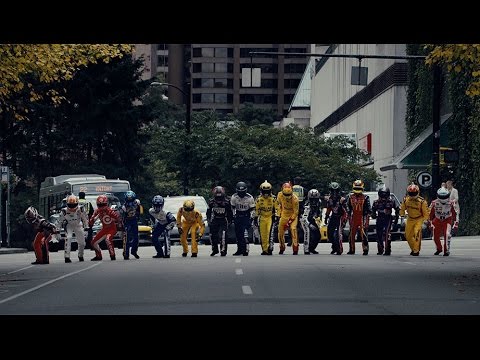
The execution uses a direct parallel structure, which is its greatest strength. The campaign was reportedly filmed in episodes with a rapid turnaround, allowing the creative to mirror the actual results of each playoff round. [1] This specific ad, covering the 'Round of 16,' begins by setting an epic, action-movie tone. The setup shows the drivers, anonymous in their helmets, preparing for battle not on a familiar track, but in an alien urban landscape. This immediately signals that this isn't standard race footage. The body of the film cleverly uses real race commentary as the narrative engine. Every stumble, every surge, every elimination in the parkour chase is directly tied to a real on-track event described by the announcers. When the commentary mentions Martin Truex Jr.'s bad luck, we see his character fall; when he later wins, we see him triumph. This transforms the ad from a simple promotional piece into a dynamic, stylized recap that rewards existing fans who know the backstory while entertaining newcomers with pure action. The payoff for each 'race' within the ad—cutting to the actual win on a TV screen—grounds the fantasy in reality before the chase resumes. This structure effectively educates viewers on the elimination format of the playoffs, showing the field of competitors getting smaller as the ad progresses. The final shot of the remaining drivers moving on, with the winner of the round front-and-center, clearly establishes the narrative for the next 'episode.'
The debrief for this campaign should center on the power of translating brand concepts literally. NASCAR took the name 'The Chase' and built an entire world around it. The key learning is that when your product's core drama is hard to visualize, creating a powerful metaphor can be more effective than showing the product itself. The integration of real-time results was a logistical feat that created immense relevance for the core audience. [1, 3] While the three-minute runtime is long for a typical ad, as a piece of social-first brand content, it functions as a short film designed to be shared and discussed, which was a stated goal of the campaign. [1, 3]
Theme Keywords
Brand Position
NASCAR is the ultimate arena for high-stakes, high-drama athletic competition.
Brand Archetype
The Gladiator
Creative Game Plan
Dramatize the intensity of the NASCAR playoffs by re-imagining 'The Chase' as a literal, urban parkour footrace between the drivers.
Diagnosis: Issues & Solutions
Primary Issue: Emotional Connection
The Problem:
The ad is thrilling but lacks a human, emotional anchor. Because the drivers are helmeted and anonymous for 99% of the runtime, they function as interchangeable action figures rather than real people enduring a struggle. We feel the adrenaline of the chase, but not the personal triumph or heartbreak of the individuals.
The Solution:
Incorporate one or two 'helmet off' moments. For example, when a driver is eliminated, show a quick, stylized shot of the real driver's face reacting with frustration or exhaustion before they disappear from the chase. This would bridge the gap between the stuntman and the athlete.
Secondary Issue: Clarity of "What's Next?"
The Problem:
The call-to-action is a completely disconnected end card. It feels like a legal requirement tacked onto a creative film, rather than an integrated part of the experience. It misses the opportunity to convert the viewer's excitement into immediate action.
The Solution:
Weave the CTA into the narrative. For instance, the final shot could have the lead driver pull out a phone to see the next 'level,' with the screen showing the Chase bracket and the NASCAR.com/TheChase URL, inviting the viewer to play along.
Additional Notes
Related Links
Credits
Share this Analysis
More NASCAR ad breakdowns
- NASCAR 75: The roads that carry us forward (narrated by Dale Jr.)NASCAR
- NASCAR 75th Anniversary - "Zuri"NASCAR
- The Chase is OnNASCAR
- Sport. And More Than Sport: Olympic Spirit.The Olympics
- Show the World: 2022 Winter ParalympicsTeam USA
- Bring It HomeInternational Cricket Council (ICC)
- It's A Wimbledon ThingWimbledon
- Paris is ready, are you? | #Paris2024 💙🤍❤️The Olympic Games