The Angry Birds Movie - Official Teaser Trailer (HD) - Ad Analysis

AI Editor notes
Straight from the gut!!
“Honestly, this looks way better than it has any right to be. They spent the money and it shows. But can they really stretch a one-note game into a full movie? This trailer smartly focuses entirely on character to distract us from asking that question. It's a solid, funny introduction, but they're fighting for relevance against an IP that peaked years before this movie came out.”
Quick Summary
This teaser's sole job was to convince a skeptical audience that a simple mobile game could be a legitimate, character-driven comedy. It accomplishes this by sidelining the game's simple mechanics and instead showcasing A-list comedic voice talent, high-quality animation, and a simple, relatable premise: one grumpy guy in a world of mandatory happiness. The strategy was to sell the characters, not the catapult.
Executive Summary
This teaser trailer for The Angry Birds Movie had a difficult strategic problem to solve: how do you turn a one-dimensional mobile game, whose popularity was already waning by 2015, into a must-see cinematic event? The answer provided by this execution is to ignore the game's mechanics almost entirely and instead build a classic, character-driven comedy.
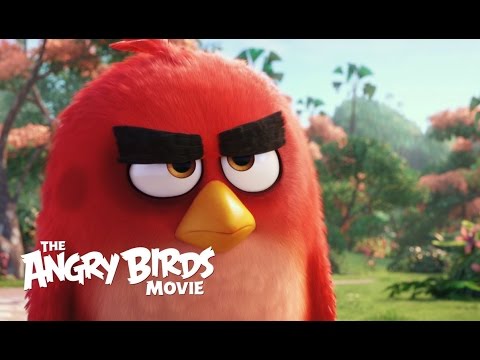
The core insight driving the creative is that even in a seemingly perfect world, there's always an outsider—and that feeling of being a perpetual misfit is a deeply relatable human (or avian) truth. The entire trailer is built around Red, a bird with a temper problem on an island of pathologically happy inhabitants. This immediately establishes a central conflict that is far more compelling than birds being flung at pigs. It's a story about personality, not physics.
The execution follows the YouTube ABCD framework effectively. It Attracts viewers with a clever bait-and-switch, opening with lush visuals and a gentle cover of '(They Long to Be) Close to You.' This serene mood is violently shattered by Red's first outburst, a hook that grabs attention by subverting expectations. The Brand is introduced immediately with the iconic character of Red, ensuring no one mistakes what this is about. It Connects with the audience through the universal humor of Red's frustration. Scenes like his deadpan response ('I'm horrible') or his final snap at the laughing 'Welcome' sign are designed to make the audience laugh with his anger, creating an emotional bond. Finally, it Directs the viewer with clear title cards for the movie name and the 'Summer 2016' release window, setting a clear expectation for action.
The debrief for the team would be that this was the absolute right strategy. Instead of trying to explain the game's logic, they sold a comedy film starring A-list talent like Jason Sudeikis and Josh Gad. [1] They transformed the brand from a simple game into a narrative property. The high production values and sharp comedic timing signal that this isn't a cheap cash-in but a serious entry into the competitive animated feature market, giving the brand its best possible shot at a second life on the big screen.
Theme Keywords
Brand Position
The funny, edgy, and star-powered animated comedy for the whole family.
Brand Archetype
Jester
Creative Game Plan
Establish that the film is a character-driven comedy that answers the one question everyone has about the game: why are the birds so angry?
Diagnosis: Issues & Solutions
Primary Issue: Strategic Sense
The Problem:
At 2 minutes and 37 seconds, the teaser is overly long for its purpose. A teaser should leave the audience wanting more, but this one introduces the main characters, their core personality flaws, and the arrival of the antagonists. It feels more like a full trailer, potentially showing too much of the core premise too early.
The Solution:
A tighter, 90-second cut focusing exclusively on the central premise—'Why is Red so angry?'—and ending with the reveal of the pigs would have been a more disciplined and impactful teaser, saving the other character introductions for the main trailer.
Secondary Issue: Clarity of "What's Next?"
The Problem:
While 'Summer 2016' is a standard CTA for a teaser, it's a passive one. The description box contains links to social channels, but the video itself does little to actively drive viewers there.
The Solution:
A simple end-card graphic encouraging viewers to 'Follow us for more character reveals' or visit the website could have capitalized on the trailer's momentum to build a more engaged digital community in the months leading up to the release.