Second Life Sounds - Ad Analysis

AI Editor notes
Straight from the gut!!
“This is refreshingly stylish for a telco sustainability brief. Most corporate e-waste ads are preachy public service announcements full of sad landfill b-roll. Putting The Avalanches on top of a stark white garbage truck playing a synth made from old circuit boards is sharp and visually arresting. It makes recycling feel creative rather than like a chore.”
Quick Summary
Telstra turns abstract corporate sustainability into tangible cultural capital by building a functioning modular synthesizer entirely out of reclaimed e-waste alongside The Avalanches. Rather than lecturing consumers about recycling old phones, the brand demonstrates the literal creative potential of discarded technology through an authentic, artist-led product hack.
Executive Summary
Telstra’s 'Second Life Sounds' tackles a stubborn consumer behavior problem: millions of unused smartphones and electronics sit forgotten in desk drawers because consumers view e-waste disposal as inconvenient. Most corporate messaging in this arena defaults to guilt-tripping statistics about landfill volume. Telstra and agencies +61 and Bear Meets Eagle On Fire take the opposite route, transforming discarded technology into an object of genuine cultural desire.
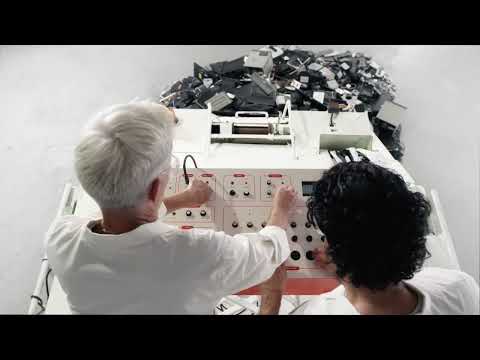
The execution relies on a tight Problem–Solution–Proof framework built around high-concept art direction. The hook at 0:00 opens in darkness before a massive white garbage truck dumps a pile of black electronic waste across a sterile white soundstage. This visual contrast strips away the grim aesthetic of a dump and frames the debris as raw material. At 0:09, the film pivots to the proof: a bespoke, cream-and-red analog modular synthesizer crafted from repurposed phone components and circuitry.
The casting of The Avalanches serves as the conceptual linchpin. Known globally for pioneering sample-based music by stitching together discarded vinyl records, the duo embodies the philosophy of sonic recycling. Showing Robbie Chater and Tony Di Blasi atop the truck performing a fresh composition on this reclaimed machine proves the concept in real time. The film concludes by connecting the stunt to Telstra's broader e-waste initiative alongside Eco E-Waste.
The strategic lesson here is about proof over preachiness. When a category leader wants consumers to change habits around sustainability, manufacturing a tangible, functional proof point creates far more conversation and cultural resonance than running conventional informational ads.
Theme Keywords
Brand Position
Australia's leading network taking tangible responsibility for the lifecycle of the hardware it distributes.
Brand Archetype
Creator / Ruler (Personality: Innovative, Visionary, Responsible)
Creative Game Plan
Demonstrate device circularity by physically turning discarded e-waste into an iconic, fully playable electronic musical instrument.
Diagnosis: Issues & Solutions
Primary Issue: Clarity of "What's Next?"
The Problem:
The film succeeds as a conceptual spectacle but lacks a clear retail or trade-in pathway on screen, leaving viewers unsure where to drop off their old phones.
The Solution:
Add a brief end-frame visual cue or URL indicating that devices can be dropped off at any Telstra store for recycling or credit.
Secondary Issue: Emotional Connection
The Problem:
The stark, high-fashion gallery treatment keeps the tone slightly detached and intellectual rather than warm or universally accessible.
The Solution:
Feature brief close-up glimpses of everyday personal devices being disassembled to ground the art piece back into the viewer's personal possessions.
Additional Notes
Credits
Share this Analysis
More Telstra ad breakdowns
- Telstra | Wherever we goTelstra
- Telstra | Scamageddon 90Telstra
- Is this a pointless ad?Telstra
- Telstra | Wagga Wagga is better on a better mobile networkTelstra
- Telstra | Together is for ChristmasTelstra
- Look Behind YouVerizon
- Virgin Mobile Campaign keeps it simple and bets on good vibes themeVirgin Mobile
- Meet India's most unique auto driver | Fast & Curious | Ep. 1Airtel