Pee on a Plant – Plan P Halftime Campaign - Ad Analysis

AI Editor notes
Straight from the gut!!
“This is ridiculous in the best way possible. Taking the urban legend of the 'Super Flush' and turning it into a legit PSA about nitrogen pollution is brilliant guerrilla thinking. It shocks you just enough to stop you from scrolling, delivers actual chemistry without sounding like a lecture, and gives a memorable call to action. It is weird, but it completely sticks.”
Quick Summary
Rich Earth Institute hijacks the synchronized halftime bathroom break of the biggest sporting event in America to turn an awkward biological taboo into an actionable, nitrogen-rich environmental solution.
Executive Summary
The Core Insight: Environmental messaging often suffers from abstraction and moral fatigue; asking everyday consumers to save water or reduce nitrogen runoff usually feels distant and demanding. The creative team at LERMA/ and the Rich Earth Institute anchored this campaign in a relatable human reality: the universal, urgent halftime dash to the restroom during the Super Bowl. By connecting the natural biological reflex of 120 million viewers to the ecological concept of circular nutrient recycling, the campaign turns an unconscious routine into a conscious micro-action.
The Execution: The film utilizes a structured Problem–Solution–Proof narrative framework tailored for viral engagement and CTV distribution.
- The Hook & Problem (0:00–0:24): The spot establishes tension with documentary-style pacing, referencing 'Sunday, February 8th' and the 120 million viewers glued to screens. It transitions from party montages to graphic animations of desperate fans holding their bladders, introducing the 'Super Flush'—the sudden surge where millions of gallons of clean drinking water wash away simultaneously.
- The Turn & Value (0:25–0:40): Visuals shift from drying reservoirs and cracked earth to the deadpan presentation of 'Plan P.' The music transforms from ominous to playful as the narrator delivers the core premise: 'This halftime, when you go, go with purpose. Pee on a plant.'
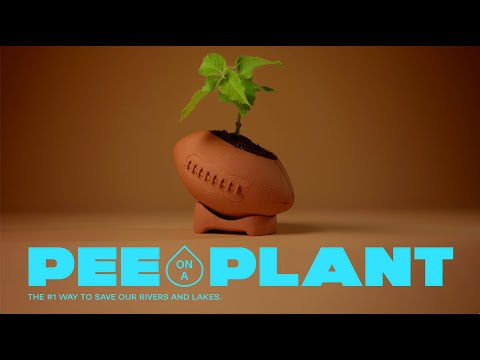
- The Proof & Demonstration (0:41–0:52): Rather than relying solely on the gag, the film grounds the absurdity in agronomy. It displays the chemical markers for Nitrogen (N), Phosphorus (P), and Potassium (K) over whimsical imagery of a classic Manneken Pis-style statue aiming into a ceramic football planter, explaining that urine is plant food that harms municipal waterways when mixed with sewage.
- The Ask (0:53–1:00): The film resolves with bold teal typography, the pun 'The #1 Way to Save Our Rivers and Lakes,' and a direct URL prompt driving viewers to explore the broader scientific initiative.
The Debrief: The central takeaway for marketers is the power of cultural judo—hijacking an established consumer habit during an existing mega-event rather than attempting to manufacture new attention from scratch. By refusing to preach and embracing an irreverent, self-aware tone, the campaign removes the friction of environmental education and generates genuine talkability.
Theme Keywords
Brand Position
The pioneer in circular sanitation and community-scale nutrient reclamation.
Brand Archetype
The Jester-Rebel: irreverent, blunt, and scientific.
Creative Game Plan
Reframe human waste into valuable organic fertilizer by leveraging the collective cultural timing of the Super Bowl halftime bathroom break.
Diagnosis: Issues & Solutions
Primary Issue: Strategic Sense
The Problem:
The literal call to action ('Pee on a plant') during a mid-winter indoor sports party in early February presents obvious domestic and social boundaries that may lead audiences to treat the spot solely as a joke rather than an educational gateway.
The Solution:
Briefly visualize a clean, socially acceptable domestic method (like diluting into a watering can or utilizing outdoor yards) to clarify that this is actionable circular agriculture, not just backyard mischief.
Secondary Issue: Emotional Connection
The Problem:
The rapid pivot from serious drought imagery to toilet humor risks alienating viewers who might feel the ecological urgency is trivialized.
The Solution:
Ensure the transition bridge between the environmental threat and the humorous remedy carries a tighter verbal rhythm so the ecological premise lands with equal weight.