Mahomes and Snoop Say Hello to iPhone 16 ON US | T-Mobile - Ad Analysis

AI Editor notes
Straight from the gut!!
“So, we're doing the celebrity bait-and-switch again. It’s a tried-and-true formula, sure. Mahomes and Snoop are likable. But does this feel like T-Mobile? Or does it just feel like 'big company with a big checkbook'? It’s funny enough, but it’s wallpaper. The strategy is so overt—get attention, shove offer—that it lacks any of the 'Un-Carrier' charm that used to set the brand apart. It will probably work, but it won't be remembered.”
Quick Summary
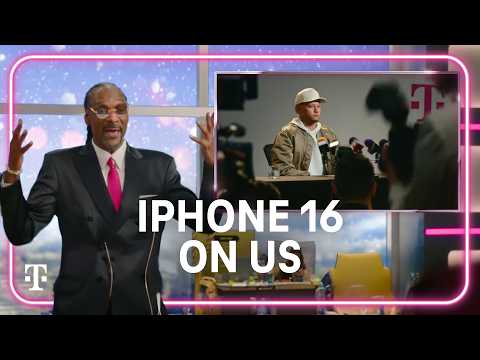
This ad uses a classic misdirection playbook, leveraging the combined star power of Snoop Dogg and Patrick Mahomes to hijack the cultural excitement of a sports announcement and channel it into a hard-hitting retail offer for the new iPhone 16. It's a pure performance play designed to drive customer acquisition during the critical holiday season by making an aggressive value proposition the punchline.
Executive Summary
T-Mobile’s holiday spot with Patrick Mahomes and Snoop Dogg is a textbook example of a high-budget, celebrity-driven, direct-response ad disguised as brand entertainment. It doesn’t waste time with subtlety; its entire structure is built to generate a moment of borrowed interest and resolve it with an aggressive retail offer. The core strategy is a classic bait-and-switch, leaning on a simple human truth: we are conditioned to pay attention to high-stakes announcements from famous people. The ad cleverly hijacks the visual language of a major sports press conference to create a hook that demands viewership.
The execution follows a clean Setup-Turn-Payoff structure. The Setup (0:00-0:07) establishes the drama. Snoop Dogg, in his now-familiar role as a pop-culture commentator, sets the stage. The chaotic press scrum and the news chyron, 'IS MAHOMES SAYING GOODBYE?', create genuine narrative tension. For a few seconds, the audience is led to believe they're witnessing a real sports story. The Turn (0:08-0:11) is the pivot and the punchline. Mahomes reveals he's not leaving his team, but his 'old phone.' This quick, clean reveal releases the tension and transitions the ad from a spectacle into a commercial. The Payoff (0:12-0:28) is the entire point of the ad: the offer. Once attention is secured, T-Mobile uses the remaining runtime to hammer home the value proposition with clear, bold graphics: 'Four iPhone 16 ON US,' '4 lines $25/line.' Snoop’s final line—'Y’all giving it away too fast'—serves as a final reinforcement of the offer's value, framing it as an unbelievably good deal.
The creative decision to use Snoop Dogg as a commentator and Mahomes as the subject is a smart pairing. It combines the credibility and hype of a top athlete with the laid-back, humorous charisma of a music and media icon, broadening the ad's appeal across multiple demographics. However, the reliance on celebrity and a straightforward joke means the ad lacks a deeper brand message. It does little to build on T-Mobile's 'Un-Carrier' identity, which was once its key differentiator. Instead, it places T-Mobile in the same category as its competitors: a large corporation using famous faces to announce a deal. The debrief for the team is clear: this formula works for short-term sales goals. It grabs attention and communicates a compelling offer efficiently. But it's a tactic, not a long-term brand-building strategy. The risk is that over-reliance on this model can dilute the unique brand personality that T-Mobile worked so hard to establish.
Theme Keywords
Brand Position
The smart, value-driven choice for wireless that gives you more without the hassle.
Brand Archetype
The Jester (using humor and disruption to challenge the establishment) with elements of the Everyman (siding with the customer against 'the other big guys').
Creative Game Plan
Use a classic misdirection comedy sketch with A-list celebrities to create an unskippable hook for a strong holiday retail offer.
Diagnosis: Issues & Solutions
Primary Issue: Brand Distinctiveness
The Problem:
The ad's creative concept is generic. Beyond the magenta branding, nothing in the execution is uniquely 'T-Mobile.' Any competitor could have run this ad with different celebrities, making it effective at a retail level but weak at building long-term, ownable brand equity.
The Solution:
Weave the 'Un-Carrier' ethos into the narrative. The offer itself should be positioned as a move only T-Mobile would make—an antidote to typical carrier nonsense. Instead of just a deal, it should feel like a statement of the brand's pro-consumer philosophy.
Secondary Issue: Emotional Connection
The Problem:
The ad creates a shallow emotional connection based on the fleeting humor of the premise and the borrowed charisma of its stars. The feeling is 'That was clever,' not 'I feel great about T-Mobile.'
The Solution:
Connect the act of 'switching' to a more relatable human insight. Frame the upgrade not just as a transaction for a new phone, but as a smarter choice that brings a family tangible benefits, relief, or joy, tying the offer to a more durable emotion.