Hero Honda "We Care" initiative - Ad Analysis

AI Editor notes
Straight from the gut!!
“This is a fossil, but a fascinating one. A motorcycle brand talking about being 'environment friendly' in the mid-90s is strategically ahead of its time. The execution is sleepy and the 'pollution-free' claim is a massive stretch for a combustion engine. Still, you have to respect the foresight. They weren't selling mileage or speed; they were selling a conscience. It's a pure brand play that probably stood out against a lot of noisy, feature-focused ads of the era.”
Quick Summary
In just 15 seconds, this ad effectively repositions Hero Honda from a mere mode of transport into a symbol of responsible progress. By linking its motorcycle to a 'clean, pollution-free experience'—a novel concept for the category in 1990s India—the brand carved out a unique, forward-thinking identity focused on corporate citizenship and care for the next generation.
Executive Summary
This Hero Honda 'We Care' spot is a textbook example of a market leader using advertising not just to sell a product, but to define its character. Released in an era when Indian motorcycle advertising was dominated by functional benefits like fuel efficiency and durability, this ad makes a deliberate pivot to a higher-order value: environmental responsibility. It’s a move that attempts to future-proof the brand by aligning it with a growing, albeit nascent, social consciousness.
The core insight driving this work is the idea that the Indian consumer, particularly the family-oriented man, is beginning to look beyond the immediate utility of a product. He is concerned about the world he is leaving for his children. The ad taps into this by creating a simple, almost utopian, equation: a happy family life equals a clean environment, and a Hero Honda motorcycle is a harmonious part of that picture, not a disruption to it.
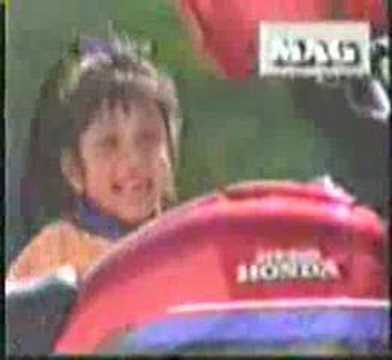
The execution follows a simple Setup-Turn-Payoff structure. The Setup (0:00-0:04) establishes an idyllic mood with visuals of a father and daughter in a pristine, green landscape. The gentle music and soft-focus visuals create a sense of peace and purity. The Turn (0:05-0:10) introduces the product, the motorcycle. Critically, the bike doesn't shatter the peace; it becomes part of the family's gentle enjoyment. The voiceover delivers the surprising core premise: this machine is part of a "clean, pollution-free experience." The Payoff (0:11-0:15) is the direct branding. The logos and the explicit tagline, "India's environment friendly bike. We care," cement the association. The brand isn't just a name; it's a promise of corporate citizenship.
The key takeaway from this campaign is the power of pre-emptive positioning. By identifying and owning a value like 'care for the environment' before competitors, Hero Honda established itself as a forward-thinking leader. While the creative execution is simple and feels dated by modern standards—the pacing is slow and the emotional impact is mild—its strategic brilliance lies in its simplicity and focus. It doesn't try to do too much. It has one job: to plant the seed of an idea that Hero Honda is the responsible choice for a modernizing India. In that, it succeeds.
Theme Keywords
Brand Position
The responsible motorcycle for a cleaner tomorrow.
Brand Archetype
The Caregiver
Creative Game Plan
Dramatize the idea that choosing a Hero Honda is an act of care for the environment and the next generation.
Diagnosis: Issues & Solutions
Primary Issue: Strategic Sense
The Problem:
The central claim of a 'pollution-free experience' from a gasoline-powered motorcycle is a significant overstatement. While 'environment friendly' is a softer, more defensible term used later, the initial claim lacks credibility and opens the brand to criticism for greenwashing, even by the standards of the time.
The Solution:
The messaging should have been anchored to a tangible proof point, however small. For example: 'With an engine designed for lower emissions, it's a step towards a cleaner ride.' This grounds the aspirational message in a believable product feature.
Secondary Issue: Emotional Connection
The Problem:
The interaction between the father and daughter is generic. It shows a pleasant moment but doesn't build a memorable, poignant story that would give the 'We Care' message a stronger emotional anchor.
The Solution:
A micro-story could have elevated the ad. For instance, showing the daughter pointing at a butterfly, and the father stopping the bike to look with her, would create a specific, touching moment that better dramatizes the idea of caring for the small, beautiful things in nature.
Additional Notes
Credits
Share this Analysis
More Hero Honda ad breakdowns
- Hero Honda Super SplendorHero Honda
- Hero Honda CBZ commercial 3Hero Honda
- Hero Honda "We Care" initiativeHero Honda
- Hero Honda CBZ commercial 2Hero Honda
- Hero Honda SplendorHero Honda
- 1985: Hero Honda CD100 - Young Salman KhanHero Honda
- Hero Honda Splendor PlusHero Honda
- Hero Honda CBZ commercial 1Hero Honda