Foot Vs. Fountain Test - Ad Analysis

AI Editor notes
Straight from the gut!!
“This is a classic challenger brand play. It screams, "While other brands use lifestyle marketing, we're in the lab—or in this case, a fountain—proving our tech works." The "Foot vs. Fountain" concept is a solid visual hook. But is "midsole geometry" a compelling enough reason-to-believe for the average person? It feels like an engineering demo dressed up for a commercial, which might work for gear-heads but could feel a bit cold to everyone else.”
Quick Summary
ASICS uses a high-stakes, visually striking product demo to prove a technical feature—midsole geometry for lateral agility—making a scientific benefit feel visceral and exciting. It’s a strategic move to position ASICS as a serious contender in the broader, more dynamic cross-training market, shifting perception from a brand known solely for running.
Executive Summary
This ASICS ad is a textbook example of a challenger brand using a product demonstration to carve out a niche in a crowded market. In 2012, ASICS was a powerhouse in running but a lesser name in the general training space dominated by Nike and Adidas. The 'Foot Vs. Fountain Test' is a direct assault on that perception, using a visually arresting 'test' to prove a specific technical advantage: lateral agility.
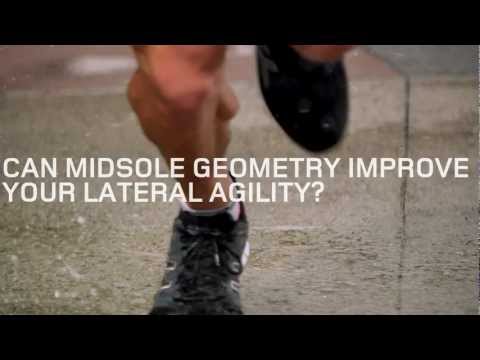
The core insight driving this work is that serious athletes trust proof over promises. They are bombarded with marketing about lightweight materials and energy return, but this ad bypasses abstract claims and opts for a tangible, if fictionalized, experiment. The creative decision to frame this as a 'test' rather than a traditional commercial is the key. It repositions the ad from a piece of marketing to a piece of evidence. The question posed at the start—'Can Midsole Geometry Improve Your Lateral Agility?'—sets up a scientific hypothesis that the rest of the ad proceeds to 'prove.'
The execution follows a clean Problem-Solution-Proof structure. The problem is the need for lateral stability in a world of unpredictable forces, visually represented by the chaotic fountain jets. The solution is the GEL-Blur33 TR shoe, worn by a credible ASICS Elite Athlete, Jake Arnold. The proof is the entire middle section of the ad: through dramatic slow-motion and impactful close-ups, we see Arnold master the course. The cuts are sharp, the sound design is visceral, and every shot of the shoe gripping the wet surface reinforces the central claim. By the time 'Test Complete' appears on the screen, the viewer has been led to a clear conclusion. The ad succeeds by making an engineering concept, 'midsole geometry,' feel dynamic and essential.
The debrief for the team that made this would be positive. They proved that a technical feature can be the hero of an ad without resorting to boring diagrams or voiceover. By creating a compelling visual metaphor for the problem (the fountain), they made the solution (the shoe) seem indispensable. It’s a smart, focused piece of communication that understands its audience—the discerning, performance-driven athlete—and speaks to them in a language of action and results, not just lifestyle imagery.
Theme Keywords
Brand Position
The scientifically-engineered performance shoe for the serious, data-driven athlete.
Brand Archetype
The Sage
Creative Game Plan
Prove our shoe's superior agility by subjecting it to a visually impossible, high-stakes 'torture test' that makes the technical benefit feel real.
Diagnosis: Issues & Solutions
Primary Issue: Emotional Connection
The Problem:
The ad is highly effective as a technical demonstration but remains emotionally cold. It showcases the product's function but fails to connect with the viewer's personal drive, the 'why' behind the grueling training, making it admirable but not necessarily inspiring.
The Solution:
Incorporate a brief voiceover or opening shot that frames the athlete's motivation. A simple line like, 'They say speed is straight ahead. They're wrong,' would add a human dimension and emotional stake to the technical test that follows.
Secondary Issue: Strategic Sense
The Problem:
The reliance on technical jargon like 'Midsole Geometry' risks alienating a portion of the audience who aren't deeply versed in footwear technology. The visuals do the heavy lifting, but the language itself could be a barrier.
The Solution:
Lead with the benefit, not the feature. Frame the initial on-screen question as, 'Can your shoes make you quicker sideways?' Then, at the end, present 'Midsole Geometry' as the answer. This flips the script to be more audience-centric.
Additional Notes
Related Links
Credits
Share this Analysis
More ASICS ad breakdowns
- ASICS | The Desk BreakASICS
- ASICS Training - What's NextASICS
- The ASICS Pigeon WorkoutASICS
- Urban TreadmillASICS
- Speed Shopping - Shoes for Every AthleteDICK'S Sporting Goods
- #PowerbyBata | #PowerStrongerInsidePower
- Run. Like we're meant to | Craft SportswearCraft Sportswear
- Merrell – Nothing But The RunMerrell