ASICS | The Desk Break - Ad Analysis

AI Editor notes
Straight from the gut!!
“This is smart. Really smart. Instead of another spot with beautiful people running in slow motion, they found a genuine cultural pain point—the soul-crushing return to the office—and hired the world's most terrifying boss to be our champion. Using Logan Roy to tell us to 'F*** the fruit' and take a break is a perfect creative judo move. It's funny, it's memorable, and it makes ASICS look like they actually get it. This is how a challenger brand gets attention.”
Quick Summary
By casting Brian Cox not as a product endorser but as a cultural icon hijacking the conversation, ASICS transformed a simple corporate wellness message into a viral moment. The ad weaponizes his 'Succession' persona to attack office drudgery, making the brand's 'Sound Mind, Sound Body' philosophy feel urgent and relevant to a massive, underserved audience: the modern office worker.
Executive Summary
ASICS' 'The Desk Break' is a sharp, strategic pivot from typical sportswear advertising. Instead of focusing on athletic achievement, it targets a much larger and arguably more stressed demographic: the global office worker. The campaign demonstrates a keen understanding that the modern wellness conversation has moved from the gym to the cubicle. By rooting the campaign in research about the mental decline caused by sedentary work, ASICS gives its longstanding 'Sound Mind, Sound Body' philosophy a tangible, modern-day enemy: the desk.
The Core Insight here is that for millions, the biggest obstacle to well-being isn't a lack of ambition, but the crushing demands of corporate culture. The feeling of being 'locked' to a desk is a universal pain point, and superficial perks like 'free fruit' are increasingly seen as insulting distractions from real issues. ASICS taps directly into this cynicism.
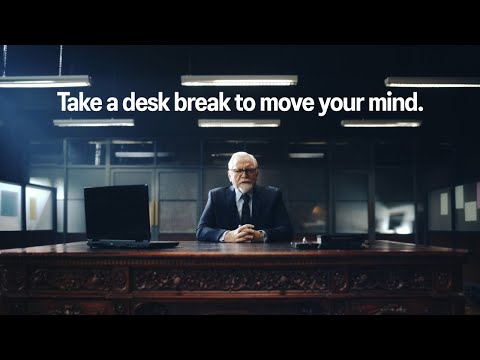
The execution follows a classic Setup-Turn-Payoff structure, amplified by a powerful cultural hook. The Setup is the entire first act: Brian Cox, channeling his terrifying Logan Roy persona, delivers a menacing monologue in a bleak, oppressive office. The lighting is cold, the tone is severe. He establishes the problem—the desk is a 'killer'—and articulates the viewer's frustration. The Turn is the critical moment he stands up, revealing he's wearing business on top, but party (and ASICS) on the bottom. The visual gag instantly shatters the tension, transitioning the ad from a threat to an invitation. This is the payoff's catalyst. The Payoff is his final, direct command: 'Run, jump, roller-skate... Just move. For your mind.' He transforms from a symbol of the problem (the scary boss) to the champion of the solution. The ASICS product isn't the hero; the act of moving is the hero, which the product merely enables. This makes the brand feel like an ally rather than a seller.
The debrief for the team is clear: cultural relevance trumps product-pushing. Finding a genuine enemy that your brand can believably fight is a powerful strategy. The casting wasn't just a celebrity endorsement; it was a piece of cultural commentary that gave the campaign immediate viral potential. By stepping outside the expected category tropes and speaking to a real-world frustration, ASICS made itself more relevant than any ad featuring an Olympian ever could.
Theme Keywords
Brand Position
The sportswear brand that champions movement as essential for a sound mind, not just a sound body.
Brand Archetype
The Sage/Liberator
Creative Game Plan
Use the world's most intimidating boss to liberate office workers from the tyranny of their desks.
Diagnosis: Issues & Solutions
Primary Issue: Clarity of "What's Next?"
The Problem:
The film itself is a brilliant piece of awareness, but the tangible 'next step' for a viewer is somewhat disconnected. The core campaign idea—the 'Desk Break Clause' that companies can adopt—is a powerful, actionable tool but isn't mentioned in the film, living instead in the YouTube description and wider PR.
The Solution:
Integrate a subtle, non-intrusive visual cue in the final seconds, perhaps a simple URL or hashtag like '#DeskBreakClause', to bridge the gap between the film's inspiration and the campaign's tangible action. This would guide motivated viewers from feeling understood to taking concrete action.
Secondary Issue: Emotional Connection
The Problem:
The ad masterfully uses humor and intimidation, but it risks keeping the viewer at an arm's length emotionally. The focus is on a single, powerful figure talking *at* the audience. We never see the target audience (the office workers) and their moment of relief or release.
The Solution:
A 1-2 second montage at the very end showing quick cuts of real office workers getting up, stretching, or walking out the door could have added a layer of human connection and made the call to action feel more communal and achievable.