Bus kelambiduchu. Kaiyila chillarai illa 😲 Orey tension! - Ad Analysis

AI Editor notes
Straight from the gut!!
“It's a sweet, simple, slice-of-life spot. The setup is instantly relatable for anyone in India. The solution is presented clearly. But let's be honest, could Google Pay or PhonePe have run this exact same ad? Yes. The only thing that makes it Paytm is the final logo and the 'Paytm Pesum' tagline. It's solid, competent work but lacks a truly distinctive, competitive edge.”
Quick Summary
This ad effectively demonstrates that Paytm UPI can resolve the common, stressful situation of not having cash change by enabling instant bank transfers using only a mobile number. It frames the product not just as a tool, but as an enabler of simple, kind interactions, turning a moment of friction into one of connection.
Executive Summary
Paytm’s “Bus Kelambiduchu” is a textbook example of the Problem-Solution narrative, executed with a charming, regional flavor. It’s a workhorse of an ad, designed less for creative awards and more for the clear, simple task of feature education. In a hyper-competitive fintech market, where features are often commoditized, the strategic bet here is that a relatable, human story can create a stronger memory trace than a dry, functional demo.
The Core Insight: The simple human truth at the heart of this ad is that small transactional frictions, like not having exact change, create disproportionate moments of social anxiety and awkwardness. Cash is clunky. This inconvenience can interrupt a pleasant moment—like buying flowers—and turn it into a minor crisis. Paytm positions itself as the agent that smooths over these everyday bumps, preserving the positive human interaction underneath.
The Execution: The ad follows a classic Problem-Solution arc.
- Problem (0:01-0:08): The setup is immediate and efficient. A young woman on a bus wants to pay a vendor. The dialogue “I have no change” followed by the vendor’s “I don’t have any either” establishes the universal dilemma. The bus starting to move adds a layer of time pressure and tension. This is a well-understood scenario for the target audience, requiring no complex explanation.
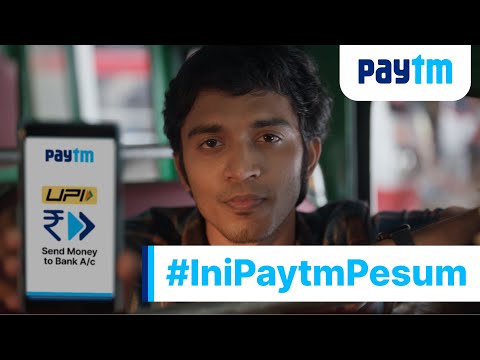
- Solution (0:09-0:23): A 'hero' character introduces the fix. The young man doesn't just have a solution; he demonstrates it. The key moment is when he asks for the vendor's mobile number, not a QR code or UPI ID. The voiceover explicitly states the value proposition: “To use UPI on Paytm, only a mobile number is enough.” The on-screen UI shots serve as the product demo, showing the process from entering the number to the confirmation screen. This visual proof is crucial for building trust and educating the user.
- Payoff (0:24-0:29): The payoff is twofold. Functionally, the vendor gets paid, and we see her smile of relief. Emotionally, the tension is resolved, and the ad pivots to a charming, flirtatious exchange between the two passengers. The woman asking for the man’s number cleverly ties into the campaign tagline, “Ini Paytm Pesum” (Now, Paytm will do the talking), suggesting the transaction was a conversation starter.
The Debrief: The team should recognize this ad as a success in clarity and relatability. It proves that you can land a specific, functional message (pay anyone with just a phone number) inside an emotional, narrative wrapper. The key learning is that for mass-market tech products, demonstrating the 'how' within a relatable 'why' is powerful. However, the debrief must also address the strategic vulnerability: its lack of distinctiveness. In the future, the challenge will be to find scenarios that only Paytm could uniquely own, moving beyond the generic problems of the category.
Theme Keywords
Brand Position
The simplest and most reliable way to handle everyday payments.
Brand Archetype
The Everyman
Creative Game Plan
Demonstrate how Paytm's UPI feature solves the universal Indian problem of not having loose change, turning a moment of tension into one of connection.
Diagnosis: Issues & Solutions
Primary Issue: Strategic Sense
The Problem:
The ad's biggest pitfall is its interchangeability. The core problem and solution could be replicated by any major competitor like Google Pay or PhonePe. It relies entirely on the final logo and tagline to establish the brand, making it strategically vulnerable.
The Solution:
Future campaigns should lean into a more defensible brand territory. Instead of generic payment problems, focus on scenarios that highlight a feature unique to Paytm or build on the "Paytm Pesum" platform by showing how the app facilitates more than just a transaction, perhaps enabling community or connection in a way competitors aren't.
Secondary Issue: Emotional Connection
The Problem:
The pivot to a 'meet-cute' romance at the end, while charming, feels a bit cliché and slightly undercuts the authenticity of the initial problem-solution story. The more powerful emotional moment is the vendor's relief, which gets less screen time.
The Solution:
Amplify the emotional payoff for the small merchant. Instead of the passenger asking for the other's number, a more potent ending might have shown the vendor using that digital money for something important, reinforcing the idea that Paytm empowers the micro-economy. This would shift the emotional focus from a light romance to meaningful economic enablement.
Additional Notes
Related Links
Credits
Share this Analysis
More Paytm ad breakdowns
- How to Add Money to your Paytm Account? [Hindi]Paytm
- Paytm IPL 2021 Ad - The Salon (English)Paytm
- Achaar Paytm karna possible?Paytm
- Book 'Shubh Mangal Zyada Saavdhan' ticketsPaytm
- Book #Baaghi3 tickets on PaytmPaytm
- Household Bill Payments on PaytmPaytm
- Paytm IPL 2021 Ad - The Ice-cream (English)Paytm
- Paytm IPL 2021 Ad - The Tailor (English)Paytm