Aunties Assemble - Ad Analysis
 Pixloop Studio
Make ads like this in Pixloop Studio.

Create motion design videos you can edit.
Want an ad like this for your brand?
Pixloop Studio writes the script and generates the video. Sign up free and get 50 credits. No card needed.

AI Editor notes
Straight from the gut!!
“Okay, this is smart. Really smart. It takes a genuine cultural insight—the 'have you eaten yet?' question as code for 'I love you'—and blows it up into a ridiculous action-movie parody. [9, 10] Who is this for? It’s for every first or second-generation kid who has an army of aunties ready to mobilize at the first sign of hunger. It feels authentic, not like a marketing team read a Wikipedia page. The brand gets to be both the hero and the punchline. Solid.”
Quick Summary
This ad successfully anchors Panda Express to the powerful cultural insight that for many, especially in Asian families, providing food is the primary language of love. By turning the caring 'auntie' into a competitive action hero, the spot creates a funny, memorable, and highly specific brand story that still feels universal: when you need to show you care, Panda Express is the answer.
Executive Summary
In the crowded fast-casual space, being good isn't enough; you have to mean something. Panda Express's 'Aunties Assemble' is a confident and clever piece of brand-building that eschews product-pushing for a much stickier emotional territory: family love, expressed through food.
The core insight is powerful and authentic: in many cultures, and particularly in Asian families, the question 'Have you eaten yet?' is a proxy for 'I love you.' [9] It's an act of service, a sign of care. Panda Express takes this simple truth and transforms it into a high-octane, humorous narrative. This ad is part of a larger campaign platform, 'Have You Eaten Yet?', which has consistently focused on family dynamics and cultural connection. [5, 7]
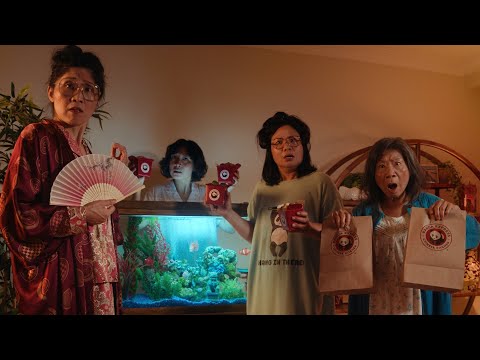
The execution, structured as a classic Setup-Turn-Payoff, is what makes it work. The Setup (0:00-0:05) is simple: a young woman is hungry. This triggers a telepathic signal to her auntie, immediately establishing a world where the need for food is an emergency that summons a hero. The Turn (0:06-0:18) is the comedic engine of the spot. We expect a simple delivery, but instead, we get a 70s action movie parody. The aunt, in fuzzy slippers and a housecoat, drives a vintage muscle car with reckless abandon, slides over the hood, and literally kicks the door in. The film language here is pitch-perfect, from the dramatic score to the intense close-ups. But the real turn happens when she finds she's been beaten to the punch by another auntie. The conflict isn't about saving her niece; it's about being the first to show her love. The Payoff (0:19-0:26) reveals that it's not just two aunties, but a whole squadron, all armed with the same weapon of affection: Panda Express. The brand isn't just a solution; it's the unanimous solution. The final punchline, where the niece scolds them for being 'too old' and they gasp in offense, lands the humor perfectly. It grounds the fantastical story in a relatable, funny family moment.
The debrief for the team is clear: when you have an authentic cultural insight, you've earned the right to be playful and confident. The ad doesn't feel like it's pandering; it feels like it's celebrating a real cultural dynamic with a knowing wink. By making the brand the centerpiece of this competition of care, Panda Express elevates itself from a convenient meal option to a meaningful gesture. It's a smart play from a market leader [3, 4] looking to secure its place not just in stomachs, but in hearts.
Theme Keywords
Brand Position
The official meal for showing you care.
Brand Archetype
The Caregiver (with a Jester's sense of humor).
Creative Game Plan
Turn the act of getting takeout for a loved one into a heroic, action-movie spectacle.
Diagnosis: Issues & Solutions
Primary Issue: Strategic Sense
The Problem:
The ad is so effective at brand building within its core Asian-American target that it might be slightly less resonant for viewers completely unfamiliar with the 'auntie' cultural archetype. The humor and action parody are universal, but the full emotional depth is reserved for those 'in the know'.
The Solution:
Future iterations could include a brief visual or verbal cue that explicitly frames the 'auntie' as a universal figure of overwhelming love, perhaps a quick line like 'Every family has one.' This would onboard a wider audience to the core insight more quickly without diluting the authenticity.
Secondary Issue: Clarity of "What's Next?"
The Problem:
The campaign's tagline, 'Have you eaten yet?', is a brilliant emotional prompt but a soft call to action. It inspires a feeling but doesn't explicitly drive an immediate behavior like ordering online or visiting a store.
The Solution:
For digital placements, this creative could be paired with a simple end card or banner that adds a direct action, such as 'Show them you care. Order now.' This would bridge the gap between long-term brand love and short-term sales without altering the successful core creative.