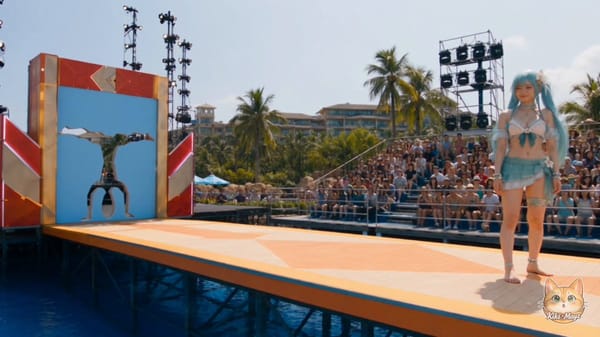
OUTPUT: 15-second live-action video, 4:3 landscape. Shot to look like real broadcast footage from a 2000s Japanese outdoor sports/variety challenge show, captured on an actual TV camera. Bright sunny daytime at a giant water park. Real-time playback only - no slow motion, no replays, no freeze frames, no excessive cinematic effects. REFERENCE IMAGES: Venue reference - a giant outdoor challenge set built over a pool. A short straight orange stage in the center, a small launch gate in the background, and a giant light-blue panel inside the gate. The panel has a human-shaped cutout in the center matching a wide-leg three-point handstand. A camera platform beside the stage, audience seating, lighting rigs, TV cameras, and the pool around it. Maintain this venue layout throughout. Character reference — keep the main character's face, hairstyle, hair color, skin tone, makeup, body type, outfit, accessories, and apparent age fully consistent. Use the exact outfit from the reference. Starting layout reference — a straight line from Point A's gate → panel → stage → the character facing Point A → the edge of Point B → the pool. Use this as the baseline composition. Pose reference — the wide-leg three-point handstand: crown of the head and both hands on the floor, legs spread wide and horizontal to the sides. POINT A / POINT B: The launch gate and panel side (upstage) is fixed as Point A. The stage-front pool edge where the character stands is fixed as Point B. Throughout the entire video, the panel's direction of travel is always A→B — never reversed, even across camera cuts. The character stands at Point B, initially facing Point A's gate and panel. The panel moves from A to B at a constant speed, and does not stop on contact — it keeps pushing. It only stops the instant the character falls into the pool; the panel itself never falls into the water. OBJECTIVE: The character must instantly match the pose shown by the human-shaped cutout on the approaching panel and pass through the hole. The required pose is a "wide-leg three-point handstand" — crown of the head, right hand, and left hand as the three support points, body inverted, legs spread wide in a straight horizontal line. Under pressure, she completes the correct pose before the panel arrives. However, the cutout is slightly smaller than her body, so her shoulders, hips, and thighs catch at the edges and she cannot pass through. The failure is due to size only, never a wrong pose. Pushed by the panel, she falls into the pool at Point B. She surfaces with her hair wet and disheveled, cheeks puffed out, silently glaring at the camera. SET & PANEL: Keep the venue structure fixed throughout. Point B is the pool-side edge just in front of the stage — the orange flooring ends right behind her heels, and just past that is almost pool water. No extra floor, walkway, railing, or open space between her and the pool. Point A has a small launch gate from which the giant light-blue panel advances straight toward B; rails/guides stay unobtrusive. The panel is a single thin, rigid broadcast-style board — it stays vertical, moving A→B without rotating, tilting, wobbling, or deforming. The cutout is a true see-through opening (not a painted silhouette) shaped for the handstand, with the head and both hands meeting the panel's lower edge. Keep the cutout shape fixed — sized just barely too small to pass through. ORIENTATION LOCK (critical): At the start, she stands at B facing Point A. Without turning her body, without looking back, without a 180° rotation, she folds forward in place toward A and enters the handstand. Sequence: face A → bend forward toward A → hands to floor → crown of head down between the hands → hips lift → legs spread wide. As a result, once the handstand is complete, the back of her head and back face Point A (the panel), while her face, chest, and stomach face Point B (the pool). After completing the pose, she never turns her face back toward A, and never twists her neck to look at the panel. This head-away-from-panel, face-toward-pool relationship is maintained all the way through impact. PERFORMANCE: Confident expression at the start. The instant she sees the cutout, her eyes widen and she gives two short shouts of "eh? eh?" — comically flustered but not running around, moving straight into the pose. During the handstand, she doesn't turn to look at the panel — she shows urgency to complete the form in time. On impact, emphasize confusion and surprise ("the shape was right — why can't I get through?") over pain. After falling in, no shouting, no crying, no laughing, no dialogue — just her cheeks puffed out, mouth closed, glaring straight into the camera. TIMELINE 0:00–0:02 — Wide ENG shot showing Point A's gate/panel, the straight stage, the character at Point B, the edge of B, and the pool right behind it, all in one frame. She faces Point A, heels almost at the pool's edge. Start buzzer. Panel begins moving A→B. She reacts with "eh? eh?" Announcer: "And we're off! This one's tough!" 0:02–0:06 — Angled medium-wide shot. Panel closes in at a constant speed. Still facing A, she bends forward, hands to floor, crown of head between her hands, hips lifted, legs spread wide horizontally. Completed orientation: back of head toward A, face toward B. Announcer: "Will she make it?! Legs are open!" 0:06–0:10 — Wide shot showing her full body and the cutout together. Panel continues A→B at constant speed and makes contact with her at Point B. The pose matches, but the cutout is too small — shoulders, hips, and thighs catch at the edges. Panel does not stop or slow on contact. Announcer: "Perfect form! But the size is off!" 0:10–0:12 — Pan following the panel pushing her. Her handstand collapses, limbs flailing as she's pushed off the edge of Point B into the pool. Big splash. Panel keeps moving through the fall and stops just short of B's edge right after. Announcer: "She's been pushed through! Unbelievable!" 0:12–0:15 — Quick zoom in as she surfaces, head and shoulders breaking the water. Hair keeps its color and length but is naturally wet and disheveled, strands sticking to her face and shoulders. Identity remains consistent. Cheeks puffed in a silent pout, glaring straight into the camera. Announcer: "The pose was right there!" Announcer stops; only audience laughter and applause play out the ending. CAMERA: 0:00–0:03 wide ENG shot only, to establish the one-way A→B motion, starting positions, and the full sequence through the fall without breaking spatial continuity — minimal pans/zooms only. 0:02–0:06 angled medium-wide, keeping her and the approaching panel in the same frame. 0:06–0:10 wide, showing her full body and the cutout simultaneously. 0:10–0:12 a pan following the push. 0:12–0:15 only, switch to a tighter telephoto for the facial reaction. Never let cuts make the panel's position jump or its direction reverse. PHYSICS / WARDROBE / SOUND: Panel moves at a constant speed from start through the fall — no breaking, deforming, or stopping on contact; it pushes with a safe, padded cutout edge rather than launching her. Outfit shape and details stay intact through the handstand, impact, and fall — no slipping, no falling off, no excessive exposure. Only wardrobe and hair get naturally wet, and only after the fall. Male announcer has the high-energy tone of a 2000s Japanese sports/variety show. Include clear buzzer, panel movement, crowd cheering, "eh? eh?", hands hitting the floor, impact, and splash sounds. Background music stays subtle. No foreshadowing of what happens next. CRITICAL RULES: Do not change the wide-leg three-point handstand into a normal handstand, shoulder stand, forward bend, straddle stand, or cartwheel. Keep the three contact points (crown of head + both hands) and legs spread wide to the sides. After the handstand completes, orientation stays back-toward-A, face-toward-B — no neck-only 180° turns, no front-back body reversal. Failure is caused only by the size mismatch, never a wrong pose — she never successfully passes through the cutout. The panel is never destroyed or submerged. No character duplication, no identity swaps, no body fusion, no extra limbs, no joint distortion, no teleportation. No blood, fractures, or fainting. No captions, subtitles, player names, timers, scores, show logos, real trademarks, or watermarks. No anime style, no game-CG look, no vertical phone framing, no extreme fisheye, no violent camera spins, no meaningless rapid cuts. Throughout, prioritize these five things above all else: the one-way A→B motion, the starting position right at Point B's edge, the back-toward-A/face-toward-B handstand orientation, the panel's continuous push, and the silent reaction after the fall.

![Use the storyboard sheet @[storyboard ref] as the exact sequential visual keyframe reference fo…](https://prompts.pixloop.ai/cdn-cgi/image/width=600,format=auto,quality=80/prompts/assets/prompts/2052670303285739933/0.jpg)
