Zydus Lifesciences: Apne Liver Ko Villains Se Bachao | #LiverKiSuno - Ad Analysis

AI Editor notes
Straight from the gut!!
“Using a celebrated Bollywood bad guy to talk about lifestyle habits as villains is a neat hook that avoids standard medical boredom. Ashish Vidyarthi is inherently likable and believable here. However, the hard shift into the white-coat doctor at the 40-second mark feels a bit textbook pharmaceutical. Still, for a non-symptomatic condition like fatty liver, turning routine habits into visible adversaries gets the job done cleanly.”
Quick Summary
Zydus cleverly reframes common metabolic risk factors—late nights, junk food, and sedentary routines—as insidious internal 'villains' by leveraging legendary cinema antagonist Ashish Vidyarthi to break the fourth wall and drive awareness for early fatty liver screening.
Executive Summary
Public health marketing around silent ailments frequently stumbles over a fundamental communication barrier: how do you get people to care about a condition that has zero immediate symptoms? Fatty liver disease is largely undetectable in early stages, making routine awareness messaging easy for consumers to dismiss. Zydus Lifesciences tackles this inertia with the '#LiverKiSuno' campaign by reframing invisible physiological risk into a recognizable cultural trope—the cinematic villain.
The Core Insight: Most people know their lifestyle habits—late nights, constant snacking, lack of movement—are suboptimal, but they compartmentalize them as harmless everyday indulgences rather than active threats. Because the liver rarely causes early pain, people assume everything inside is fine.
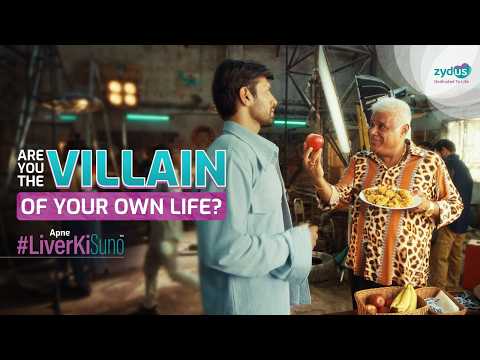
The Execution: Employing a Setup–Turn–Payoff structure, the film opens in what appears to be a high-stakes Bollywood action drama. Renowned cinematic villain Ashish Vidyarthi sadistically tortures a captive protagonist with food. The 'Setup' is disrupted at 0:10 when the director calls 'Cut!' and the film set environment is revealed. The 'Turn' occurs naturally at the craft services table: as the junior actor compliments Vidyarthi's terrifying performance, Vidyarthi pivots the conversation from fictional villains to real internal adversaries—uncontrolled eating, lack of exercise, and irregular sleep. Offering an apple over fried pakoras, he leaves the junior actor with a moral choice: 'Do you want to be the villain of your life, or the hero?' The film then transitions into the 'Payoff' through a brief clinical endorsement and statistical breakdown (nearly 40% at risk), ending on a clear mandate to book a liver scan.
The Debrief: The commercial succeeds because of disciplined casting. Ashish Vidyarthi possesses decades of equity playing intimidating antagonists, making his self-aware commentary on villains credible and disarming. Rather than adopting an alarmist or patronizing medical tone, the creative relies on casual mentorship to prompt behavioral reflection. While the final act retreats into standard pharmaceutical visual tropes, the storytelling vehicle in the first half ensures the central takeaway lands memorably.
Theme Keywords
Brand Position
A thoughtful healthcare leader committed to preventive well-being and early disease detection.
Brand Archetype
Sage / Caregiver (Authoritative, protective, enlightening)
Creative Game Plan
Subvert popular cinema tropes by having a famous movie villain expose everyday lifestyle habits as the true, silent villains threatening liver health.
Diagnosis: Issues & Solutions
Primary Issue: Strategic Sense
The Problem:
The abrupt transition from high-production narrative storytelling into a generic clinical explainer dilutes creative momentum in the final 20 seconds.
The Solution:
Keep Ashish Vidyarthi integrated into the diagnostic explanation or allow the narrative metaphor to carry the statistics rather than cutting to a standard white-coat doctor.
Secondary Issue: Clarity of "What's Next?"
The Problem:
The call to action ('Consult your doctor about a quick liver scan') lacks a digital touchpoint, QR code, or landing page for viewers seeking immediate risk self-assessment.
The Solution:
Include an interactive self-assessment link or QR code driving traffic to a dedicated screening locator or educational portal.