Who will you Share A Coke with? - Ad Analysis

AI Editor notes
Straight from the gut!!
“It's a really smart, well-crafted piece of film. The visual metaphor of digital clutter versus real-world connection is instantly understandable and relatable. It takes a campaign idea that could feel dated ('Share a Coke' is over a decade old) and makes it feel fresh and urgent for a new generation. It’s confident, warm, and effective.”
Quick Summary
This isn't just an ad; it's a strategic reboot of Coca-Cola's most successful modern campaign, 'Share a Coke,' precision-targeted at Gen Z. The core move is using the proven, nostalgic power of personalized bottles to address a very current problem: digital overload. The ad argues that a simple Coke is the catalyst to break free from the noise of social media and online distractions to create a moment of 'real magic'—an authentic, in-person connection. It's a smart play that reinforces the brand’s timeless positioning while making it feel necessary in 2025.
Executive Summary
Coca-Cola's 2025 'Share a Coke' revival is a clinic in how a legacy brand can speak to a new generation without losing its soul. The ad operates on a simple, powerful human truth: in an era defined by digital connection, we feel the absence of real-world presence more than ever. [2, 6] The entire creative is built around this tension.
The execution follows a classic Setup-Turn-Payoff structure. The setup introduces us to three young protagonists, each isolated and visually overwhelmed by the 'noise' of modern life—notifications, tasks, and data, all rendered as slick, floating graphics. A student in a library is surrounded by swirling equations; a young woman in a corner store is bombarded by social media icons; a bike courier navigates a city of timers and maps. This is the problem: a life lived through a screen.
The turn is subtle and human-scaled. It's not a grand event, but a simple text message. A plan is made to meet at a specific time. This small act of reaching out is the catalyst for the change. The ad proves its point in the transition. As the characters decide to meet, the digital clutter begins to fade. The courier weaves through traffic, the student packs his bag—they are moving with real-world purpose now, not just reacting to digital prompts.
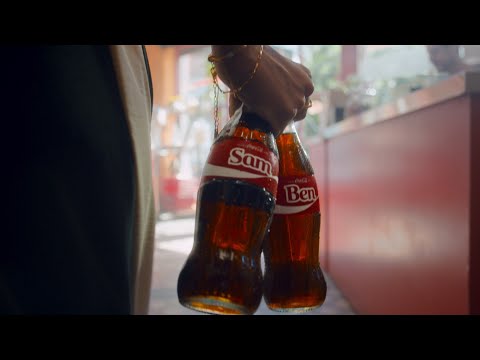
The payoff is the moment of 'Real Magic.' The three friends meet in a sun-drenched park. The digital noise is completely gone. All that's left is them, a chessboard, and the iconic glass bottles of Coca-Cola they share. The strategic takeaway is clear: Coca-Cola is the antidote to digital fatigue. It’s not just a drink; it's the physical token of a real connection. For the business, this repositions Coke from a simple refreshment to a tool for well-being and social bonding, a smart move to compete in a market crowded with functional and energy drinks. [6] The key lesson for any brand team is that you don't always need a new idea. Sometimes, the most powerful strategy is to take your most iconic asset and find the right cultural problem for it to solve.
Brand Position
Based on this ad, the brand's position is: 'The Official Sponsor of Real Moments.' Coke is the simple, tangible bridge from online planning to offline connection.
Brand Archetype
The Innocent. Its personality is optimistic, timeless, and genuine. It believes in the simple, pure goodness of connecting with others.
Creative Game Plan
The core creative idea was to contrast the anxiety of our cluttered digital lives with the simple joy of an in-person connection, using a shared Coke as the catalyst for that transition.
Diagnosis: Issues & Solutions
Primary Issue: Emotional Connection
The Problem:
The ad successfully evokes a feeling of warmth and connection, but this emotion is not entirely exclusive to Coca-Cola. The idea of 'breaking free from technology to connect with friends' is a broad, almost generic, category benefit that could be claimed by a coffee brand, a beer, or even a board game. The reliance on this universal theme, while effective, slightly dilutes the uniqueness of the brand's emotional territory.
The Solution:
The execution could have leaned more into a uniquely 'Coke' feeling. Perhaps by incorporating a more distinct sound design—like the iconic 'fizz' and 'clink' of the bottles—more prominently in the transition moments, tying the relief from digital noise directly to the sensory experience of the product itself, not just its presence in the final scene.
Secondary Issue: Strategic Sense
The Problem:
While reviving 'Share a Coke' is strategically sound, it's also a conservative choice. The campaign was a phenomenon for millennials. [4, 6] For Gen Z, who grew up with algorithmic personalization as the default, the novelty of a name on a bottle might be diminished. The biggest missed opportunity is the choice to iterate on an old platform rather than inventing a *new* culturally iconic platform for this generation.
The Solution:
A braver strategy might have been to use this same core insight—the need for real connection—but to build a completely new, Gen Z-native participation platform. Instead of putting names on bottles, perhaps it could have been a campaign centered on co-created experiences or local meetups, using the bottle as a token for entry, thus creating a new legacy instead of just polishing an old one.
Additional Notes
Related Links
Credits
Share this Analysis
More Coca-Cola ad breakdowns
- COCA-COLA | O ANO DA VIRADACoca-Cola
- The Lost Voices | Football World Cup FandomCoca-Cola
- McVeggie + Coke Zero @ Just ₹149!Coca-Cola
- Coca-Cola | It's Magic When the World Comes Together | Paris 2024 | Global Coca-Cola
- Kıpır Kıpır Bir Coca-Cola?Coca-Cola
- Pilav Show! - #TadınıÇıkarCoca-Cola
- Coca-Cola: Te tocó nacer acáCoca-Cola
- Just Add Coke Zero to Subway's New Hot & Cheesy Signature SubsCoca-Cola