The Golden Minute: Why the First 60 Seconds After Birth Matter Most - Ad Analysis

AI Editor notes
Straight from the gut!!
“This is a heavy-hitter. It walks a fine line between being a powerful social-impact film and a manipulative ad, and it stays on the right side. Using the primal fear of a silent newborn is a bold, risky move, but it pays off because the story feels true. It's smart that Johnson's isn't the hero; the trained nurse is. The brand is the sponsor, the force behind the scenes. This builds a kind of trust that no product feature ever could.”
Quick Summary
Johnson's Baby elevates itself beyond product attributes by tackling the terrifying, real-world issue of birth asphyxia in India. Through a raw, emotional film, the brand positions itself not as the hero, but as the quiet enabler of heroes—the healthcare workers it has trained for 16 years—powerfully cementing its core promise to protect babies from the very first minute of life. [1, 2]
Executive Summary
In a market saturated with claims of 'gentle' and 'natural,' Johnson's Baby sidesteps the product feature arms race entirely with 'The Golden Minute.' Instead of talking about what's in the bottle, it addresses a terrifying real-world problem: neonatal mortality in India. This two-minute film is a powerful piece of social-impact marketing that functions to solidify the brand's position as the ultimate authority on infant well-being.
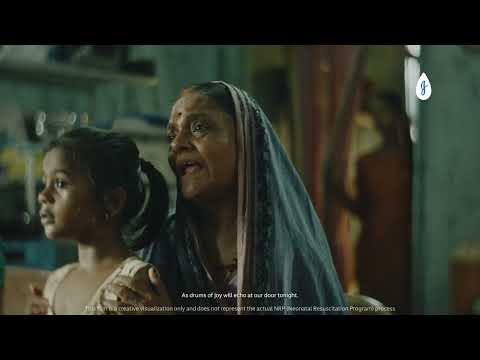
The core insight is simple yet profound: for a new parent, the single most important moment is their baby's first breath. The ad leverages the universal fear that this breath might not come. The execution follows a classic Problem-Solution-Proof structure, delivered with cinematic grit and raw emotional honesty. The 'Problem' is established instantly with the sounds of labor followed by a chilling silence. The anxious questions from the family—'Why isn't the baby crying?'—articulate the viewer's own rising panic. The 'Solution' is not a product, but a person: a calm, trained healthcare worker who performs neonatal resuscitation. The use of a traditional 'Sohar' lullaby, sung by the other mothers in the ward, is a masterful creative choice. It transforms a moment of individual fear into an act of communal hope and prayer, grounding the film in its cultural context. [2] The 'Proof' comes in two stages. First, the baby's cry—an immensely satisfying emotional payoff. Second, the hard facts presented via on-screen text: 1.2 lakh newborns die annually, but intervention in the first minute can increase survival by 50%. [1, 4] The final piece of proof connects it all back to the brand: 'For 16 years, Johnson's Baby has supported training & equipping of over 2 lakh doctors, nurses & midwives.' [1] This isn't just an ad; it's a report on a long-term investment, lending it immense credibility. The debrief for the team that made this is to recognize the power of showing, not telling. The film doesn't say 'trust us'; it shows a reason why you should trust them. By making the healthcare professional the hero and casting itself in a supporting role, Johnson's Baby earns its 'Caregiver' archetype. It’s a strategic move that elevates the brand above competitors and into the realm of public good, creating an emotional connection that is difficult to break.
Theme Keywords
Brand Position
The trusted partner in protecting infant health from the very first minute.
Brand Archetype
The Caregiver
Creative Game Plan
Dramatize the life-or-death stakes of a baby's first breath to prove that Johnson's promise of protection extends to the most critical moment of all.
Diagnosis: Issues & Solutions
Primary Issue: Strategic Sense
The Problem:
The film brilliantly establishes Johnson's Baby's commitment to social good, but the connection back to its commercial products is entirely absent. For a skeptical viewer, this could raise questions about motive, potentially creating a disconnect between the CSR initiative and the brand's core business.
The Solution:
Bridge the gap subtly in future content. For example, include a brief shot in the training montage showing healthcare workers being taught the importance of using clinically mild and safe products on a newborn's skin after resuscitation, without explicitly showing a Johnson's bottle. This would link the life-saving act to the brand's product philosophy of 'gentle care'.
Secondary Issue: Clarity of "What's Next?"
The Problem:
The call to action is passive, directing viewers to a website to 'learn more.' After such a powerful emotional experience, the audience is primed for a more meaningful action, but is given a generic one.
The Solution:
Implement a more participatory call to action. Instead of just 'learn more,' prompt viewers to 'Share the film to help us reach more healthcare workers' or create a simple mechanism on the website that allows for a non-monetary pledge of support, making the audience feel like partners in the mission.