Where Does a Donation Go? - Ad Analysis

AI Editor notes
Straight from the gut!!
“This works because it avoids the typical guilt-tripping pity porn of legacy charity commercials. It answers the fundamental donor objection—'where does my money actually go?'—in under fifteen seconds. The yellow dotted line connecting the equipment to the patient's smile gives a clean, direct visual explanation. Simple, ethical, and motivating.”
Quick Summary
By physically tracing the direct path of donor capital from open waters into specific surgical tools and immediate patient outcomes, the ad effectively demystifies non-profit overhead and transforms abstract giving into tangible human restoration.
Executive Summary
The humanitarian NGO sector often defaults to distress-driven imagery designed to provoke guilt. Mercy Ships takes a smarter, modern fundraising approach by framing charitable giving as a concrete logistical journey rather than an ambiguous transaction.
The Core Insight stems from donor skepticism. Modern contributors rarely question whether medical poverty exists; they question organizational efficiency and transparency. They want to know the tangible journey of their dollar. By asking 'Where does a donation to Mercy Ships go?' in the first two seconds, the film directly tackles donor cynicism.
The Execution utilizes a Hook–Value–Proof–Ask framework.
-
Hook (0:00–0:04): An aerial vista of the hospital ship sailing at sunset introduces the animated yellow tracking line—a visual metaphor for the donor's contribution entering the scene.
-
Value (0:05–0:13): The tracking line weaves through physical touchpoints inside the ship docked in Madagascar: from the doctor's swab, to the MRI technician, the scalpel, and the monitor. This rapid sequence breaks down the complexity of maritime healthcare into familiar, accountable assets.
-
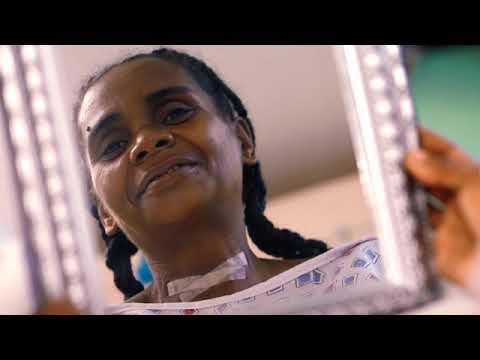
Proof (0:14–0:23): The payoff shifts from clinical tools to human transformation. A patient looks into a mirror with her neck tumor successfully removed, cutting immediately to her wedding day surrounded by her community. The piece reinforces this proof point with a quick succession of smiling patients holding their 'before' photographs, validating the long-term impact of cleft and tumor surgeries.
-
Ask (0:24–0:31): The film closes with clear, succinct value pillars ('Local medical training. Life-changing surgeries.') before resolving on a wake-shot of the ship accompanied by a persistent URL and donate directive.
The Debrief: The creative succeeds because it celebrates agency and joy rather than victimhood. It treats the donor as a partner in a surgical supply chain, making the final conversion feel earned and transparent.
Theme Keywords
Brand Position
The world's leading floating surgical hospital providing free, world-class healthcare to underserved coastal nations.
Brand Archetype
Caregiver (Compassionate, Dedicated, Restorative)
Creative Game Plan
Trace a single donation through the physical tools and personnel of a hospital ship to showcase its ultimate conversion into human restoration.
Diagnosis: Issues & Solutions
Primary Issue: Clarity of "What's Next?"
The Problem:
The closing call to action relies solely on a standard website URL without giving the viewer an immediate, frictionless conversion path or incentive (e.g., matching grant or specific dollar-amount anchor).
The Solution:
Introduce a specific giving prompt or text-to-donate trigger on screen (e.g., '$25 provides surgical supplies') to lower direct response friction.
Secondary Issue: Strategic Sense
The Problem:
The mention of 'local medical training' appears as end-card text at the very end but receives zero visual explanation during the preceding hospital tour.
The Solution:
Include a brief one-second shot of a local surgeon being mentored on board to visually reinforce the sustainability claim.