Škoda - DuoBell: The Unmissable Bike Bell - Ad Analysis

AI Editor notes
Straight from the gut!!
“Why is a car company inventing bike bells? Because it is a razor-sharp PR and brand positioning maneuver. By creating a physical, 100% mechanical tool that outsmarts billion-dollar ANC algorithms and open-sourcing the blueprints, Škoda earns genuine cultural goodwill among cyclists and city commuters. It walks the walk of 'Simply Clever' without running a predictable sheet-metal commercial.”
Quick Summary
Škoda reinforces its core 'Simply Clever' brand equity not through automotive metal, but through a purpose-driven mechanical hack that solves a contemporary urban mobility crisis, reconnecting the brand to its nineteenth-century cycling origins.
Executive Summary
The Core Insight: Modern urban mobility has quietly created a dangerous sensory disconnect. As cities encourage micro-mobility and cycling commutes, consumer technology has simultaneously cocooned pedestrians inside Active Noise Cancellation (ANC) bubbles. The humble bicycle bell—virtually unaltered for over a century—has been rendered obsolete by algorithms designed to filter out ambient sound. Škoda identifies this real-world friction: safety on shared roads requires mutual awareness, yet technology has made urban walkers acoustically blind.
The Execution (Problem–Solution–Proof): The piece follows a classic innovation case study framework. In the Setup/Problem phase (0:00–0:35), the film establishes the urban tension through London road footage, statistics (54% of sold headphones feature ANC), and media headlines regarding the 24% rise in cyclist-pedestrian collisions. Board Member Martin Jahn bridges the automotive brand to cycling by recalling Škoda's 1895 founding as a bicycle manufacturer and its two-decade Tour de France commitment.
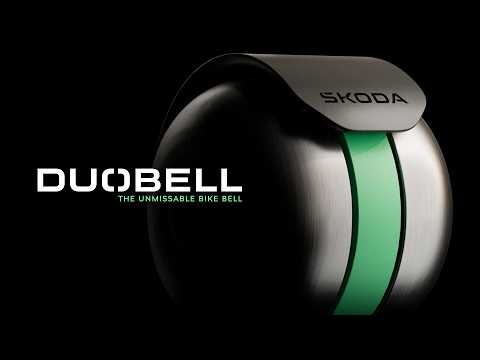
In the Solution phase (0:36–2:00), the video pivots into hardware development and acoustic science. Dr. Will Bailey from the University of Salford explains how ANC operates via phase inversion and reveals the acoustic testing that isolated an uncancelable 750 Hz 'safety gap.' Hardware lead Hugh Boys and Head of Design Oliver Stefani demonstrate how they engineered a compact, dual-resonator, 100% mechanical bell that exploits this blind spot, framing it explicitly as 'a simple, analogue solution to a digital problem' and an embodiment of Škoda's 'Simply Clever' design language.
In the Proof/Payoff phase (2:01–2:52), the campaign provides empirical and street-level validation. VR lab trials demonstrate a 22-meter and 5-second early detection improvement. Real-world validation follows via London Deliveroo couriers who enthusiastically endorse the bell's practical efficacy. The film concludes on an altruistic note by announcing that the technical blueprints and research are open-sourced and freely downloadable on Škoda's website.
The Debrief: Škoda demonstrates how legacy automotive manufacturers can stay culturally relevant in modern conversations about urban transport. Rather than stubbornly pushing car ownership to city dwellers, Škoda positions itself as an enabler of holistic street safety. By open-sourcing the design instead of commercializing it, the brand elevates the initiative from a gimmick into a legitimate corporate social responsibility and PR triumph.
Theme Keywords
Brand Position
The thoughtful, human-centric mobility brand delivering practical, clever solutions for everyday life.
Brand Archetype
Sage / Everyday Innovator
Creative Game Plan
Develop a physical, analog hardware invention that outsmarts active noise cancellation algorithms and open-source it to prove Škoda's 'Simply Clever' philosophy.
Diagnosis: Issues & Solutions
Primary Issue: Emotional Connection
The Problem:
The case study relies heavily on corporate talking heads and laboratory charts, which can feel somewhat sterile and typical of B2B or festival entry formats.
The Solution:
Injecting more raw, kinetic first-person street perspective and authentic pedestrian-cyclist close-call moments at the start would heighten the human drama before diving into acoustic graphs.
Secondary Issue: Clarity of 'What's Next?'
The Problem:
While open-sourcing the research whitepaper is admirable, individual cyclists watching the film cannot actually buy the DuoBell.
The Solution:
Provide clear guidance on retail availability, partnership rollouts with bike-share schemes, or a 3D-printable open-source file repository for consumer makers.