King Jay | Join the Kingdom - Ad Analysis

AI Editor notes
Straight from the gut!!
“This is a really smart piece of work. It avoids all the classic charity ad tropes of sadness and pity. It feels like a launch for a cool streetwear brand like Fear of God or Off-White, not a hospital fundraiser. They honored Jayden’s memory by focusing on his strength and 'fire,' not his illness, which gives the campaign integrity. It's empowering, not depressing, and that's a tough line to walk.”
Quick Summary
This campaign's core achievement is transforming a single child's wish into a tangible, aspirational apparel brand. Instead of simply asking for donations, it created a product people want to buy and a community they want to join, turning passive sympathy for a cause into active, sustainable participation.
Executive Summary
The 'King Jay' campaign is a textbook example of how to elevate cause marketing from a simple plea for help into a powerful, self-sustaining brand movement. It succeeds by rejecting the established formula of charity advertising and instead borrowing the visual language of elite sports and aspirational fashion. The campaign was created by agency Mosaic for the Children's Wish Foundation of Canada to honor the 25,000th wish granted, which belonged to Jayden Strauss, an 18-year-old who wished for custom sneakers. [1, 2] The foundation and agency smartly expanded this single wish into an entire apparel line, creating a vehicle for ongoing support. [3]
The Core Insight: The fundamental human truth this campaign leverages is that people don't just want to pity the afflicted; they want to stand in solidarity with the strong. Traditional charity ads often position the viewer as a powerful savior to a helpless victim. This ad flips the script. It positions the child, Jayden, as a 'king' and his supporters as his 'kingdom'. The act of donating by purchasing apparel becomes an act of joining a powerful, unified team, not an act of charity from a distance. This is a far more empowering proposition for the modern consumer who wants their actions and purchases to reflect their values.
The Execution: The ad uses a classic Setup-Turn-Payoff structure to masterful effect.
- Setup (0:00-0:22): The opening act is pure sports advertising. We see a lone, young Black boy on a dark, moody basketball court. The voiceover uses words like 'courage,' 'determination,' and 'battle.' The visual and narrative cues lead the audience to assume this is an ad for a brand like Nike or Under Armour, celebrating an aspiring athlete.
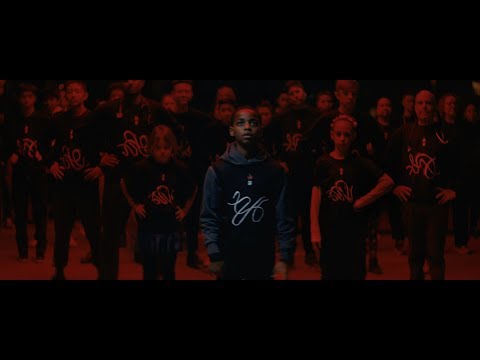
- The Turn (0:23-0:40): The crucial turn happens with the line, "And battles are never won alone." The entire scene is instantly transformed. The solitary blue-white light is replaced by an immersive, communal red glow, revealing that the boy is surrounded by a crowd—a silent army of doctors, family, and other children. This is the moment the ad reveals its true subject. The 'battle' is not for a championship; it's for his life. The 'team' is his support system.
- The Payoff (0:41-1:09): The voiceover clarifies the new reality: "Together is stronger. United we stand... in honor of one child's wish." The reveal of the King Jay brand and the CTA, "Join the Kingdom," now makes perfect sense. The apparel seen on the crowd is the uniform for this kingdom. Buying it is how you enlist. The final card explicitly connects the brand to the Children's Wish Foundation, closing the loop and giving the audience a clear, tangible action to take. [4]
The Debrief: The key lesson from 'King Jay' is the power of building a brand for a cause, rather than just advertising the cause itself. By creating a desirable product and an aspirational identity, the campaign gave people something to buy into, not just donate to. It shifted the dynamic from a one-time transaction based on guilt to a long-term affiliation based on pride and solidarity. This approach has a far greater potential for creating sustained impact and cultural relevance.
Theme Keywords
Brand Position
King Jay is the official outfitter for the fight against childhood illness.
Brand Archetype
The Hero (Jayden) and The Caregiver (The Kingdom/Foundation)
Creative Game Plan
Reframe the lonely fight against childhood illness as a collective, heroic battle, using the visual language of elite sports advertising.
Diagnosis: Issues & Solutions
Primary Issue: Emotional Connection
The Problem:
The ad's power comes from its symbolic nature, but the full, heartbreaking-yet-inspiring story of the real Jayden Strauss is not present in the film itself. Viewers who don't read the description miss the profound context that he passed away before the launch, and that his idol was 'King' LeBron James. [2, 6]
The Solution:
Subtly ground the story in its real-world origin. A simple super at the end, like 'For Jayden Strauss, 1999-2017,' or a quick shot of his signature integrated into the logo, could have anchored the powerful metaphor in its poignant reality without disrupting the film's tone.
Secondary Issue: Clarity of "What's Next?"
The Problem:
The 'Join the Kingdom' CTA is thematically perfect but strategically soft. It relies on the viewer's curiosity to visit the website to understand that 'joining' means 'buying'.
The Solution:
A slightly more direct on-screen text could have sharpened the ask. For example: 'Join the Kingdom. Wear the support. kingjay.org' would connect the abstract idea of joining with the concrete action of wearing the apparel.
Additional Notes
Related Links
Credits
Share this Analysis
More King Jay ad breakdowns
- あなたならどう着る?LEVI'S FEATURING NEWJEANS | Levi'sLevi's
- Everyday Wear for Mr. Dependable featuring Rahul DravidUniqlo
- UNIQLO Premium Linen Shirt Collection featuring Kareena Kapoor KhanUNIQLO
- Levi’s featuring NewJeans | Levi’sLevi's
- Levi’s® RAMADAN 2019 (Full version)Levi's
- Levi’s® Hidup PositifLevi's
- Levi’s® Chinese New Year: This Year, Follow Your HeartLevi's
- Levi's x Deepika Padukone | Season 3Levi's