The Great Pretenders - Ad Analysis

AI Editor notes
Straight from the gut!!
“This is clever, self-aware, and cuts straight to the point. The compact SUV category is drowning in raised hatchbacks pretending to be rugged off-roaders. Staging an 'anti-car wash' where suburbanites plaster mud on their vehicles to look adventurous is sharp satire. It reinforces Jeep's core equity without relying on clichéd off-road footage until the final punchline.”
Quick Summary
Jeep cuts through modern SUV marketing homogenization by satirizing consumer 'outdoor cosplay', reasserting its authentic off-road heritage against competitors that merely look the part.
Executive Summary
The Core Insight: The modern automotive market is flooded with compact crossovers—vehicles styled with plastic cladding, roof rails, and rugged aesthetics that rarely leave pavement. While mainstream consumers buy these vehicles to project an active, adventurous lifestyle, most acknowledge the gap between the image and reality. Jeep capitalizes on this behavioral contradiction: consumers want the social cachet of being adventurous without actually enduring the grit.
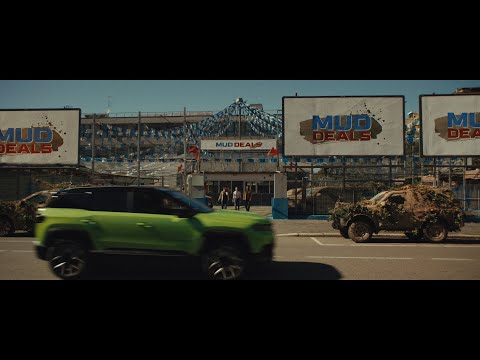
The Execution: Using a Setup–Turn–Payoff narrative structure, the commercial opens in an ordinary residential neighborhood where suburbanites meticulously apply mud, leaves, and twigs to their vehicles by hand. The humor escalates as the scene shifts to an organized commercial facility called 'Mud Wash,' complete with technicians staging faux mud splatters and dump trucks providing cosmetic dirt piles. The entire sequence is synchronized to a theatrical lip-sync of 'The Great Pretender,' turning the suburban need for outdoor validation into an overt musical farce.
The turn arrives at 0:21 when the clean, vibrant lime-green Jeep Compass enters the picture. While the crowd of posers freezes in embarrassment, the Compass driver calmly engages the vehicle's terrain management dial and heads off into legitimate wilderness. The payoff provides the contrast: real mud, genuine traction, and effortless trail driving, concluding with the definitive line: 'Some pretend. Some don't have to.'
The Debrief: Automotive advertisers frequently default to showing their compact crossovers in identical mountain landscapes, blending into category background noise. By satirizing the very trope of SUV outdoor marketing, BETC and Jeep created an ownable narrative that differentiates the Compass from competitors. The commercial demonstrates that acknowledging consumer absurdities with charm can elevate a product above technical spec sheets.
Theme Keywords
Brand Position
The authentic original 4x4 manufacturer delivering genuine capability in an era of superficial urban crossovers.
Brand Archetype
The Explorer / The Outlaw (Rugged, Authentic, Self-assured)
Creative Game Plan
Expose the superficiality of modern crossover styling through an exaggerated world of 'fake mudding' to position Jeep as the sole authentic original.
Diagnosis: Issues & Solutions
Primary Issue: Strategic Sense
The Problem:
The film relies heavily on Jeep's historical 4x4 equity, but the Compass e-Hybrid is primarily a front-wheel-drive or light-duty urban crossover rather than a dedicated rock crawler.
The Solution:
Include a brief visual cue showing the vehicle handling realistic urban daily commuting alongside mild trail capability to ground the vehicle's true dual utility.
Secondary Issue: Clarity of "What's Next?"
The Problem:
The closing card presents e-Hybrid and Electric powertrains abruptly without linking them back to the adventure premise.
The Solution:
Integrate an endframe callout highlighting quiet electric off-roading or booking a test drive to sharpen commercial conversion.
Additional Notes
Credits
Share this Analysis
More Jeep ad breakdowns
- Jeep® | Jurassic Trail Rated (Extended Cut)Jeep
- Thank you, Jeep adventurers.Jeep
- New Wrangler Rubicon 392 | V8 Engine with 470 horsepowerJeep
- #MyJeepStory | Abhimanyu AlsisarJeep
- Jeep – O Inverno ChegouJeep
- Dia 4x4: Qual é a sua próxima aventura? | #JeepDayJeep
- Jeep & Juventus - Jeep® Terrains - New TV CommercialJeep
- JEEP COMPASS | Inspirado Na NaturezaJeep