Ford New Holland Tractor Commercials Featuring Dharmendra...!!!Must Watch!!! - Ad Analysis

AI Editor notes
Straight from the gut!!
“This is so over-the-top, it’s a perfect time capsule. It’s basically a mini-Bollywood movie from the 90s, but with a tractor as the co-star. The strategy is dead simple: get India's biggest action hero and have him act possessive and tough about his tractor. It’s not subtle, but for that target market and that era? It probably worked like a charm. Who is this for? The farmer who wants to be the boss. The message is clear: this isn't just a tractor, it's a throne.”
Quick Summary
This campaign effectively leverages the 'He-Man' persona of Bollywood legend Dharmendra to position the Ford tractor not just as a piece of farm equipment, but as a powerful, personal symbol of a landowner's status, authority, and masculinity. The ads are less about features and more about an attitude, equating ownership of a Ford with the kind of dominance and control Dharmendra projected on screen.
Executive Summary
This Ford Tractor campaign, featuring Bollywood icon Dharmendra, is a masterclass in celebrity endorsement from a bygone era, one where persona-matching was the entire strategy. The ads, likely from the 1990s, aren't selling a machine; they're selling an identity. The core insight is that for the target customer—the Indian farmer and landowner—a tractor is not merely a utility vehicle. It is a profound symbol of his power, his control over his land and labor, and his status within the community. The tractor is an extension of his own self-image, and Ford seized on this by linking their product to the ultimate symbol of Indian masculinity: Dharmendra.
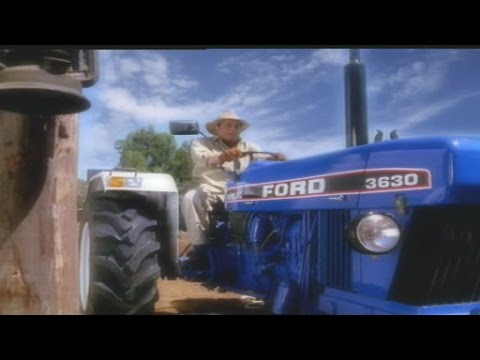
The execution is split into two short, dramatic vignettes. The first spot uses a classic Problem-Solution framework. The Setup is Dharmendra, the picture of a successful patriarch, enjoying a quiet morning. The Problem is the unauthorized starting of his Ford tractor, a violation of his personal domain. This is treated not as a minor inconvenience, but as a grave challenge to his authority. The Payoff is his immediate, aggressive confrontation with his workers. His dialogue, "Only I drive this Ford!" establishes the tractor as a possession as personal and exclusive as a king's scepter. The brand becomes inextricably linked to his power. The tagline, "Dharam ka Dharam" (a pun on his name and the word for 'duty' or 'religion'), further cements the tractor as his personal creed.
The second spot uses a Comparison narrative, pitting man and machine against nature. Here, the untamable wild horse represents raw, chaotic power. Dharmendra's inability to lasso it with traditional means sets the stage for a modern solution. The Turn happens when he confidently mounts his Ford tractor. The Payoff is his effortless control over the powerful machine, which makes the horse's wildness irrelevant. He tells the horse, "This is a Ford... how far will you run?" The message is that Ford's power is superior, more reliable, and ultimately more effective than even the power of nature. It's a clear demonstration of technological dominance, framed as personal victory.
From these ads, the debrief for the team would be clear: when your celebrity's public image is a perfect match for your brand's desired attribute, you can create a powerful emotional shortcut. The campaign didn't need to list horsepower or fuel efficiency. Dharmendra's presence was the proof of the tractor's strength. While modern advertising often demands more subtlety and a clearer call to action, this campaign is a potent reminder of the raw power of archetypal branding and a perfectly cast star.
Theme Keywords
Brand Position
The tractor for the man in charge.
Brand Archetype
The Ruler
Creative Game Plan
Fuse the on-screen persona of a legendary action hero with the tractor to personify the machine with ultimate power, status, and masculine authority.
Diagnosis: Issues & Solutions
Primary Issue: Strategic Sense
The Problem:
The campaign's tagline, "Jo Ford mein hai, woh auron mein kahan" ("What's in a Ford, where else can you find it?"), is a generic and unsubstantiated claim of superiority. While the celebrity endorsement provides emotional proof of 'power,' the slogan itself is forgettable and doesn't give the audience a concrete reason to believe in the product's uniqueness beyond its association with the star.
The Solution:
The tagline should have been tied to a specific product attribute, even a simple one. For instance, something like, "Ford. Dum hai. (Ford. It has guts.)" or linking the power to a tangible benefit like "More acres, less time. That's Ford power." This would ground the aspirational message in a semblance of product reality.
Secondary Issue: Clarity of "What's Next?"
The Problem:
The ads are pure brand awareness with no pathway for the consumer. There is no mention of a specific model (beyond what's written on the tractor), no dealer information, and no prompt to 'visit a showroom' or 'ask for a demo'. The campaign relies entirely on the brand's mystique to drive action.
The Solution:
Even a simple end-card with a call to visit a local Ford tractor dealer would have provided a crucial next step for interested buyers. This would bridge the gap between the high-level brand aspiration and the on-the-ground commercial reality of making a purchase.