CloseUp Free To Love Series Case Film - Ad Analysis

AI Editor notes
Straight from the gut!!
“This is a case study, which is an agency's victory lap. Stripping that away, the core idea is solid. It's the standard 2010s purpose-marketing playbook: find a relevant social issue, connect it to your brand's DNA, and execute with authentic stories. It's smart and it clearly worked. My only question is whether the brand can sustain this positioning authentically beyond a single campaign, or if it just feels like a tactic to chase cultural relevance and awards.”
Quick Summary
This campaign successfully modernized CloseUp's 50-year-old brand promise of 'closeness' for a new generation. By shifting the enemy from bad breath to societal judgment, CloseUp became a credible champion for the right to love freely, wrapping a social mission around its core identity and proving its relevance in today's culture.
Executive Summary
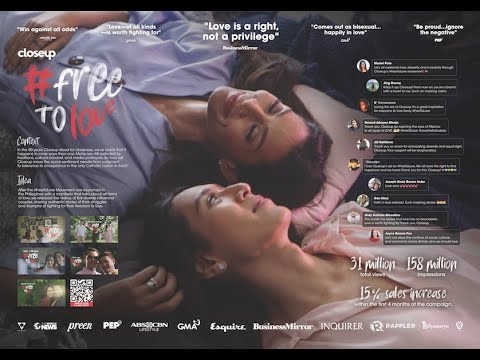
This case film for CloseUp's '#FreeToLove' campaign documents a textbook-perfect example of modern brand revitalization. For decades, CloseUp owned 'closeness,' but its narrative was stuck in a traditional, heteronormative past. This campaign represents a strategic pivot, acknowledging that for today's youth, the barriers to closeness are often not physical, but societal.
The Core Insight: The campaign is built on a simple yet powerful human truth: while the desire for love is universal, the freedom to love is not. The case study opens by stating that while 3 out of 4 young people have been in 'unconventional' relationships, half of them fear the discrimination that comes with it. This tension between a modern reality and persistent societal judgment is the engine of the entire campaign. CloseUp identified that its brand purpose couldn't just be about enabling a kiss; it had to be about defending the right to have one.
The Execution: The case film itself employs a classic Problem-Solution-Result structure to sell the campaign's success. It begins by establishing the Problem: CloseUp's 50-year-old narrative was becoming obsolete. [3] The Solution was a multi-platform campaign anchored by documentary-style testimonials. Instead of actors, they featured five real, diverse Filipino couples: same-sex couples, a couple with a significant age gap, a transwoman in a relationship with another woman, and a couple facing cultural divides. [3, 8] This use of authentic stories is the campaign's strongest creative choice, moving it from a generic statement about love to a grounded, human-centered narrative. The final act of the case film is the Result, where the agency presents its evidence: staggering numbers for views (31 million) and impressions (158 million), widespread positive press, and the crucial business metric of a 15% sales increase. The campaign hashtag, #FreeToLove, served as the connective tissue, turning individual stories into a collective movement.
The Debrief: The key lesson here is the power of evolving a brand's core purpose. CloseUp didn't abandon its long-held association with 'closeness'; it deepened it. By understanding the contemporary challenges their audience faces, they transformed their brand from a simple product for fresh breath into a proactive ally in the fight for acceptance. This shift gave them cultural currency and a renewed sense of relevance. It demonstrates that when a brand can authentically connect its product truth to a larger human truth, it can generate not just views, but brand affinity and business growth.
Theme Keywords
Brand Position
The brand that gives you the confidence to get closer, by fighting the barriers that keep people apart.
Brand Archetype
The Lover, evolving to incorporate elements of the Hero.
Creative Game Plan
Evolve the brand's meaning of 'closeness' by championing the stories of diverse couples who defy societal judgment to be together.
Diagnosis: Issues & Solutions
Primary Issue: Emotional Connection
The Problem:
The case film, by its nature as a results-oriented summary, rushes through the powerful human stories. The rapid cuts to statistics and media logos interrupt the emotional journey of the couples, prioritizing proof over feeling.
The Solution:
To better convey the campaign's power, the case film should have allowed one of the couple's stories to play out for an uninterrupted 15-20 seconds. Let the viewer feel the emotional weight of their testimony before presenting the data that proves its effectiveness.
Secondary Issue: Strategic Sense
The Problem:
The film presents the 15% sales increase as a direct, singular consequence of the campaign. This is a common oversimplification in case studies that can undermine credibility by ignoring other market factors like pricing, promotions, or distribution changes that could have contributed.
The Solution:
Frame the business result with more nuance. Instead of '15% sales increase,' use language like, 'The campaign created a cultural moment that contributed to a 15% sales lift,' acknowledging that advertising is a powerful factor among many.
Additional Notes
Related Links
Credits
Share this Analysis
More CloseUp ad breakdowns
- Patanjali Dant Kanti Toothpaste | Product by Patanjali AyurvedaPatanjali
- Colgate MaxFresh: Doctor SleepColgate MaxFresh
- Colgate Total prevents dental problems before they start | English | 20 secColgate
- Colgate Active Salt | Theater | HindiColgate
- Presenting the New Colgate Strong Teeth. Paste Hi Nahi, Daanton Ka Poshan! | HindiColgate Strong Teeth
- Colgate Toothpaste for Diabetics, created with Diabetes Experts | EnglishColgate
- Patanjali Dant Kanti Toothpaste | Product by Patanjali AyurvedaPatanjali
- Colgate Swarna Vedshakti. The perfect sangam.(Hin)Colgate