Celebrating World Toilet Day 2025 by building India's Hygiene Ki Aadat || Case Study || Pee Safe - Ad Analysis

AI Editor notes
Straight from the gut!!
“So, is this an ad, or a victory lap for the marketing team? It feels like the latter. It's smart, comprehensive, and ticks all the boxes of a modern integrated campaign. But who is this *for*? If it's for consumers, it's too long and full of metrics. If it's for other marketers, it's solid. The 'Spray Sit Flush Spray' is a clever bit of behavioral design, but the case study format makes it feel a bit self-congratulatory and less like authentic consumer communication.”
Quick Summary
This isn't just an ad for a sanitizer; it's a case study for a movement. Pee Safe effectively moves beyond selling a product to owning a social mission: creating a national habit of toilet hygiene. It identifies that the real enemy isn't a competitor but consumer forgetfulness, and solves it by creating a simple, sticky ritual ('Spray Sit Flush Spray') amplified through influencers, on-ground events, and expert validation.
Executive Summary
Pee Safe's 'Hygiene Ki Aadat' is a well-executed case study in modern brand building, moving beyond simple product advertising to orchestrate a behavior-change movement. It’s less a single ad and more the summary of a comprehensive, integrated campaign that correctly identifies its true competitor: not another brand, but consumer apathy and inconsistent habits.
The Core Insight: The campaign is built on a sharp insight: many women own a toilet seat sanitizer, but the friction of remembering to use it is the biggest barrier to adoption. The problem isn't a lack of awareness of the product, but the lack of an ingrained, automatic ritual. Pee Safe realized it needed to sell the habit, not just the hardware.
The Execution: The video follows a classic Problem-Solution-Proof structure, delivered in a fast-paced, mixed-media style suited for social platforms.
- Problem (Setup): It opens by establishing the widespread fear and disgust surrounding public toilets, using relatable user-generated style clips and a powerful statistic (74% of women avoid drinking water). It quickly pivots to the real problem: people have the product but forget to use it. The influencer testimonial from Natashaa Gandhi makes the consequence—a severe UTI—frighteningly real.
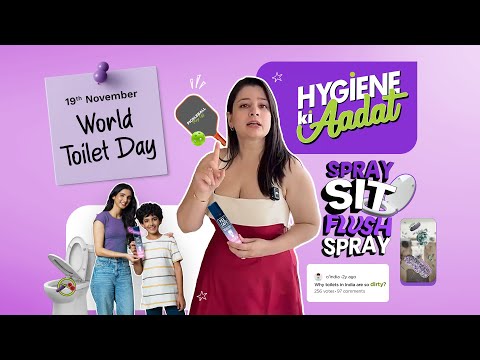
- Solution (Turn): The solution presented is two-fold. First, the brand itself commits to solving the problem with the 'Hygiene Ki Aadat' (A Habit of Hygiene) initiative. Second, it introduces a simple, memorable mnemonic: 'Spray. Sit. Flush. Spray.' This provides a clear, actionable ritual that directly addresses the core problem of forgetfulness.
- Proof (Payoff): The majority of the runtime is dedicated to proving the campaign's success and scale. Through a rapid montage, it showcases a multi-pronged attack: on-ground activations at colleges and rest stops, endorsements from doctors to build credibility, and a large-scale event ('Pickleball Play Off') to generate buzz. Flashing metrics like '25M+ reach' and '100+ locations' serve as the payoff, demonstrating that this isn't just an idea but a successful, widespread movement.
The Debrief: The key lesson from this campaign is that for categories requiring a new behavior, creating a sticky ritual is paramount. Pee Safe provides a masterclass in this by packaging the desired action into a simple, rhyming phrase and then relentlessly propagating it through every available channel—from social media to on-the-ground events. It shows that owning a problem and providing a habitual solution is a powerful way to build brand leadership and a loyal user base.
Theme Keywords
Brand Position
The enabler of fearless mobility and hygiene confidence for women in public spaces.
Brand Archetype
The Caregiver, mixed with The Ruler. It's the Caregiver by protecting users from harm (UTIs, germs) and the Ruler by seeking to impose a new, better standard of hygienic order on the world.
Creative Game Plan
Establish Pee Safe as the leader of a national health movement by teaching India a simple, unforgettable hygiene ritual.
Diagnosis: Issues & Solutions
Primary Issue: Strategic Sense
The Problem:
The video is caught between two identities: a consumer-facing ad and a B2B marketing case study. The self-congratulatory metrics and 'campaign summary' tone are effective for an industry audience but can feel alienating and overly corporate to a regular consumer just looking for a solution.
The Solution:
Create two distinct assets. A shorter, emotionally-driven ad for consumers that focuses solely on the fear/relief narrative. Then, use this existing video as a B2B asset for investors, partners, and awards, where the metrics and strategic breakdown are most relevant.
Secondary Issue: Clarity of "What's Next?"
The Problem:
After successfully convincing the viewer of the problem and the solution, the video ends on a broad mission statement ('we are not stopping...') without giving the viewer a clear, immediate next step.
The Solution:
Add a simple, direct end card. For example: 'Start your #HygieneKiAadat. Find Pee Safe online and in stores near you.' This bridges the gap between inspiring the viewer and enabling them to act.