Canva | Dil Se Design Tak | Jaadu Dadu - Ad Analysis

AI Editor notes
Straight from the gut!!
“It's a bold, confident piece of brand storytelling. At two minutes, it's banking on the narrative being strong enough to hold attention, and it is. It has the emotional weight of a classic Google or Thai Life Insurance ad, using a universal family tension to make its point. The product integration is patient and perfectly timed, making the payoff feel earned.”
Quick Summary
This ad's success hinges on positioning Canva not as a piece of software, but as a medium for emotional translation. It sidesteps the technicalities of 'design' and instead sells the tool as a bridge across a generational and emotional divide, proving that the most powerful messages are often shown, not just told. By embedding itself into a deeply relatable family conflict, Canva makes its product feel less like a utility and more like a solution for the heart.
Executive Summary
Canva's 'Jaadu Dadu' isn't selling software; it's selling reconciliation. This is a smart, patient piece of storytelling that understands its audience and its purpose. In a market where tech tools often shout about features, Canva whispers about feelings. The core insight is that creativity isn't just for artists and marketers—it's a fundamental tool for human connection. When words create conflict, a simple, heartfelt design can create peace. This ad positions Canva as the enabler of that translation, from a messy human heart to a clear, tangible design.
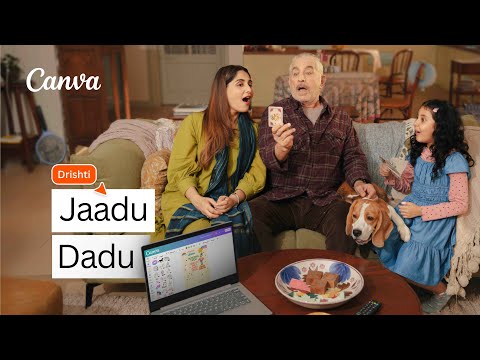
The execution follows a classic Setup-Turn-Payoff structure, which is perfect for a narrative this rich. The Setup (0:00-0:55) masterfully establishes the central conflict. We meet the whimsical 'Jaadu Dadu' (Dalip Tahil), whose love of magic is a source of joy for his granddaughter but a source of deep frustration for his daughter, Aaliya (Saloni Batra). Her line, 'Responsibilities... they're real. Unlike magic,' cuts deep and establishes a relatable, painful dynamic. The Turn (0:56-1:30) is the granddaughter's response to this conflict. Witnessing her grandfather's hurt, she doesn't argue or cry; she acts. The film pivots, and the product is introduced not as a feature-list but as a solution. She opens her laptop, and the Canva UI becomes her toolbox for healing. This is the crucial transition from problem to product-as-hero. The Payoff (1:31-2:01) is swift and effective. The 'certificate' she creates—'No Normal Daadu, Forever Only Jaadu Daadu'—is the emotional catharsis the family couldn't find through dialogue. It validates her grandfather, softens her mother, and reunites them. The tagline, 'Dil se, design tak' ('From the heart, to the design'), ceases to be a slogan and becomes the summary of the entire film.
The debrief for the team that made this is simple: emotional storytelling works, especially when the product is the genuine hero of that story. The ad successfully elevates Canva from a mere utility to a meaningful part of its users' lives. The risk of a two-minute runtime in a digital-first world is significant, but the reward is a level of brand equity that 15-second feature-focused ads can rarely achieve. The key learning is that to show a product's value, you must first establish a valuable problem for it to solve.
Theme Keywords
Brand Position
Canva is the simplest way for anyone to turn their feelings into beautiful, meaningful designs.
Brand Archetype
The Magician (turning an idea into a beautiful reality) and The Everyperson (accessible and empowering for all).
Creative Game Plan
Demonstrate that Canva can resolve a deeply emotional family conflict in a way that words cannot.
Diagnosis: Issues & Solutions
Primary Issue: Strategic Sense
The Problem:
The ad's two-minute runtime is a major asset for storytelling but a significant liability in the skippable world of digital advertising. A large portion of the audience may never reach the product integration at the 1:18 mark.
The Solution:
Develop a suite of shorter assets (6s, 15s, 30s) that are not just cutdowns, but re-edited to tell a micro-story. For instance, a 15-second version could quickly show the daughter's frustration, the granddaughter on Canva, and the final hug, getting to the point much faster.
Secondary Issue: Clarity of "What's Next?"
The Problem:
The ad does a phenomenal job of creating an emotional urge but provides no immediate outlet for it. The simple 'canva.com' CTA feels like a missed opportunity to convert emotional energy into platform engagement.
The Solution:
Connect the campaign narrative to an on-platform experience. The final screen could feature a QR code or a short URL leading directly to a template gallery for 'Family Messages' or 'Certificates of Appreciation,' allowing viewers to immediately act on the inspiration the ad provides.