Birla Opus Allwood: Football Match on the Dining Table - Ad Analysis

AI Editor notes
Straight from the gut!!
“It's clean, relatable, and gets the job done without overcomplicating things. Seeing a kid in studs on a polished dining table triggers instant anxiety for any homeowner, which makes the father's calm reaction land the product claim immediately. Is it groundbreaking? No, it's a classic FMCG-style durability demo wrapped in a family moment, but it communicates the value proposition cleanly.”
Quick Summary
Birla Opus Allwood successfully reframes functional scratch resistance as emotional permission for families to live freely inside their homes without treating furniture like museum pieces.
Executive Summary
The Core Insight: For most urban families, furnishing a home represents a significant financial and emotional investment. Consequently, beautiful wooden surfaces often turn parents into reluctant enforcers—constantly scolding children to prevent scuffs, water rings, and scratches. The tension between wanting a stylish home and wanting children to play without restriction creates low-grade household stress. Birla Opus taps into this human truth: durability in home finishes is not just an engineering spec; it provides psychological freedom.
The Execution: BBDO India uses a classic Problem–Solution–Proof narrative structure to bridge emotional storytelling with a hard product claim.
-
The Setup (0:00–0:10): The film opens with high-energy excitement. A young boy returns from a victorious football match and energetically reenacts his winning goal for his father. The momentum builds quickly, capturing the audience's attention.
-
The Problem/Tension (0:10–0:20): The boy steps straight onto the pristine dining table wearing studded football cleats. The mother rushes in with relatable panic ('Arre beta, table! Usko roko'), establishing the immediate real-world stakes that every homeowner recognizes.
-
The Turn/Solution (0:20–0:28): The father remains unbothered, replying 'Pehle goal toh hone do... apna hi ghar hai, yahin toh khul ke jeeyenge.' His composure reframes the situation from impending damage to effortless domestic comfort.
-
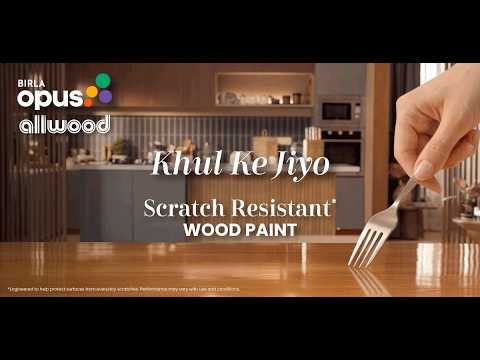
The Proof & Payoff (0:29–0:45): The film transitions to an extreme close-up of a metal fork scraping across the glossy wood finish, providing literal product proof of the 'Scratch Resistant' claim. It finishes with beauty shots of warm wooden furniture and a playful tag between the parents, reinforcing the brand's 'Khul Ke Jiyo' positioning.
The Debrief: For brand strategists, the key takeaway is the power of visual shorthand. Rather than relying on industrial test lab footage or complex polymer jargon, placing football cleats and a scraping fork on fine furniture communicates toughness faster and far more memorably than technical claims ever could.
Theme Keywords
Brand Position
The high-performance wood finish that gives modern households the freedom to live without caution.
Brand Archetype
Everyman / Caregiver with a reassuring, cheerful, and approachable personality.
Creative Game Plan
Demonstrate superior scratch resistance by contrasting high-stakes physical abuse of furniture with complete parental calm.
Diagnosis: Issues & Solutions
Primary Issue: Brand Distinctiveness
The Problem:
The dynamic between a carefree father, a strict mother, and an energetic child is a well-trodden trope in Indian household advertising, making the narrative structure somewhat generic.
The Solution:
Subvert the traditional family roles or introduce a more distinctive visual style to ensure the narrative feels proprietary to Birla Opus rather than interchangeable with legacy competitors.
Secondary Issue: Clarity of 'What's Next?'
The Problem:
The closing sequence provides broad brand positioning ('Khul Ke Jiyo') but lacks a clear next step for an intrigued homeowner or interior contractor.
The Solution:
Incorporate a subtle prompt—such as directing viewers to request an Allwood finish from their contractor or explore shades online—to channel awareness into purchase intent.