BELIEVE IN CHICKEN - Ad Analysis

AI Editor notes
Straight from the gut!!
“This is wonderfully weird. It's a big, confident, slightly unhinged swing that feels more like an art-house film than a fast-food ad. They're not selling a bucket; they're selling a belief system with a straight face and a wink. It’s the kind of work that gets remembered and talked about, even if half the audience thinks it's just plain bizarre. The commitment to the bit is fantastic.”
Quick Summary
In a world drowning in misinformation, AI weirdness, and general unreliability, KFC makes an audacious play to position its chicken as the one simple, tangible truth you can always believe in. It’s a high-concept brand statement that elevates fried chicken from a mere meal into a cultural anchor point, aiming for iconic status rather than just a quick sale.
Executive Summary
The core insight behind 'Believe in Chicken' is a sharp and timely observation: the world has become an increasingly complex, unreliable, and absurd place. [4, 6, 10] From the rise of AI to political misinformation, people are losing faith in the systems and truths they once took for granted. In this sea of chaos, there's a deep-seated craving for something simple, real, and consistently good. KFC brilliantly elevates its core product to be the surprising answer to this existential angst.
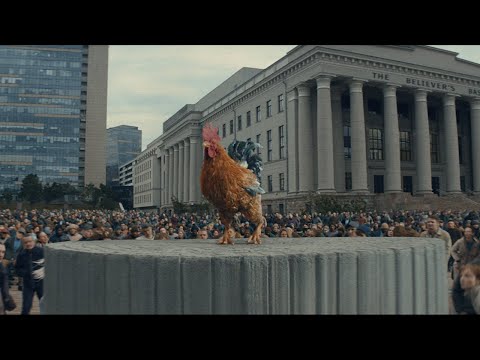
The execution follows a clear narrative arc of Setup–Turn–Payoff. The Setup establishes the 'mad world' through a series of unsettling vignettes: a news report on an AI minister, runaway prices at a charging station, and a man marrying an AI. [8] The driving, hypnotic beat and surreal visuals create an atmosphere of anxiety and confusion. The Turn happens as this individual unease coalesces into a collective, physical movement. People across the city begin performing a strange, synchronized 'chicken walk,' drawn together by an unseen force. [10] This bizarre, choreographed ritual is the creative centerpiece, transforming the initial chaos into a shared, purposeful journey. The Payoff arrives as the crowd gathers before 'The Believer's Bastion,' their devotion directed at a single, majestic chicken on a pedestal. The supers 'BELIEVE. IN. CHICKEN.' land with comedic and conceptual force, positioning the product as the one reliable constant. The final KFC logo definitively connects this newly-formed cult to the brand.
The debrief for the creative team is clear: taking a big, conceptual risk can create something far more powerful than a safe, product-focused ad. By tapping into a palpable cultural tension (modern anxiety) and offering the brand as a humorous, exaggerated resolution, they achieved immense distinctiveness. The lesson is that the bravest work often comes from ignoring category conventions and instead finding a simple, ownable truth about your brand that can serve as an anchor in a complex world. [11]
Theme Keywords
Brand Position
The simple, reliable, and universally satisfying constant in a chaotic world.
Brand Archetype
The Jester: It addresses a serious cultural anxiety (lack of trust) with a grand, ironic, and humorous solution (worshipping a chicken), subverting expectations with wit.
Creative Game Plan
Dramatize the chaos and absurdity of modern life to frame KFC's simple, reliable chicken as the only tangible thing left to believe in.
Diagnosis: Issues & Solutions
Primary Issue: Strategic Sense
The Problem:
The creative leap from a surreal, dystopian film to the everyday act of buying fried chicken is significant. While highly memorable for the creatively inclined, a portion of the mass audience might find the ad too weird or pretentious, failing to connect the high concept back to a dinner decision. The strategy risks being too clever for its own good, potentially alienating viewers who don't 'get the joke.'
The Solution:
Ground the absurdity with a final, simple moment of human satisfaction. After the grand 'Believe in Chicken' reveal, a quick, 2-second shot of a diverse group of people genuinely enjoying KFC could bridge the gap between the philosophical concept and the real-world product, making the message more accessible without undermining the creative.
Secondary Issue: Clarity of "What's Next?"
The Problem:
The campaign excels at building a mood and an idea but offers zero tangible next steps for the consumer. For a brand that relies on frequent purchases, completely omitting any link to the product experience (taste, occasion, ordering) is a bold move that may limit its direct commercial impact, leaving the viewer with a memorable feeling but no immediate impulse to buy.
The Solution:
Digitally, this brand film should be the top of the funnel. Follow it with shorter, product-focused retargeting ads that echo the 'Believe In' theme but apply it to specific menu items (e.g., 'Believe in the crunch,' 'Trust in the gravy'). This connects the high-level brand halo to actionable product desire.