A Parent's Promise: Keeping Our Children Protected & Loved - Ad Analysis

AI Editor notes
Straight from the gut!!
“This is a very safe, very 2023 piece of content marketing. It's warm, fuzzy, and hits all the right notes for its target audience of new parents. The use of local influencers is a smart, targeted play for the Malaysian market. But at over three minutes, it feels long. Does it do enough to be memorable, or does it just blend into the sea of other heartwarming but forgettable brand films? It's competent, but not groundbreaking.”
Quick Summary
Dettol moves beyond its clinical, germ-kill reputation to position itself as an essential partner in the emotional journey of modern parenthood. By using relatable local influencers to voice the universal anxiety of new parents—the fear of a child getting sick—the brand equates its products with the fundamental parental promise to protect.
Executive Summary
Dettol’s “A Parent’s Promise” is a deliberate and well-crafted pivot from the lab to the living room. For decades, Dettol’s strength has been its clinical authority—the sharp scent, the opaque liquid, the promise of near-total germ annihilation. This film trades that scientific credibility for emotional resonance, a smart move in a market where consumers, particularly Millennial parents, connect with brands that understand their lives, not just their problems. The core insight is simple but potent: the biggest change in a new parent’s life isn't the lack of sleep, it's the arrival of a profound, ever-present worry for their child's wellbeing. Sickness, once a personal inconvenience, becomes their greatest fear. Dettol smartly inserts itself as the answer to this specific anxiety.
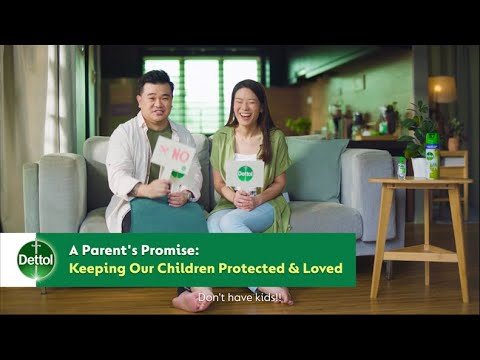
The execution uses a testimonial format, which is a fitting choice for building authenticity. By casting two real-life Malaysian influencer couples, the brand achieves both relatability and targeted reach. The structure follows a simple Q&A, exploring the realities of parenthood. It opens with a lighthearted joke—Reuben Kang holding a sign saying "NO" to having kids—which effectively disarms the viewer and signals that this isn't a lecture. The conversation then naturally flows to the core issue: the newfound obsession with cleanliness driven by the fear of germs. The Dettol products on the table aren't just product placement; they're silent participants in the conversation, the physical manifestation of the solution to the worries being discussed. The turning point is when the parents explicitly state their biggest fear is their child falling sick. This anchors the entire film. Dettol isn’t just selling a disinfectant spray; it's selling peace of mind. It’s selling the ability for a father to say he wants his child to be free to "explore as much as possible... fall down and stand up on his own again," because he trusts the environment is safe. The film closes by rewarding the parents with a hamper, positioning Dettol not as a seller, but as a supportive partner. The team should learn that emotional truth, delivered by authentic voices, can be more powerful than any scientific claim. For a market leader like Dettol, reinforcing its emotional right-to-win is just as important as defending its functional superiority. [2, 4, 5]
Theme Keywords
Brand Position
The trusted partner that provides scientifically-proven protection, giving parents the peace of mind to let their children grow and explore.
Brand Archetype
The Caregiver
Creative Game Plan
Connect Dettol to the emotional core of parenthood by showing the brand understands and alleviates new parents' deepest anxieties.
Diagnosis: Issues & Solutions
Primary Issue: Clarity of "What's Next?"
The Problem:
The film builds a strong emotional connection but completely drops the ball at the end. After investing three minutes in this heartfelt story, the viewer is left with just 'Happy Parents' Day.' There is no invitation to join a community, read more tips, or even a simple URL. It's a dead end.
The Solution:
Incorporate a simple, non-intrusive call to action. An end card with, 'For more tips on protecting your little one, visit Dettol.my' or 'Share your #ParentsPromise with us' would give engaged viewers a next step, capturing the momentum the film builds.
Secondary Issue: Brand Distinctiveness
The Problem:
The ad's central theme of parental worry is powerful but not exclusive to Dettol. The reliance on testimonials, while authentic, could be replicated by any competitor. The product is present, but its unique properties or reasons-to-believe are not woven into the narrative, making the brand feel slightly interchangeable.
The Solution:
Subtly integrate a unique brand asset beyond the logo. A brief, natural mention of 'the Dettol smell that always makes me feel it's truly clean' or a visual of the iconic cloudy effect when mixed with water could have anchored the generic emotion of 'clean' to a specific Dettol attribute without breaking the testimonial format.
Additional Notes
Related Links
Credits
Share this Analysis
More Dettol ad breakdowns
- সকল মায়েদের জানাই ডেটল-এর পক্ষ থেকে মা দিবসের শুভেচ্ছা!Dettol
- আপনার সন্তানকে রাখুন জার্মস থেকে সেইফ Dettol Warrior-দের সাথেDettol
- A New Legacy To Protect - Dettol MalaysiaDettol
- ভালোবাসার সবকিছুকে সুরক্ষিত রাখতে, ডেটল-এর সাথে লিটন ১০০% শিওর!Dettol
- Dettol Cool Soap – Be Captain Cool, With Dettol Icy CoolDettol