[BRAND NAME]
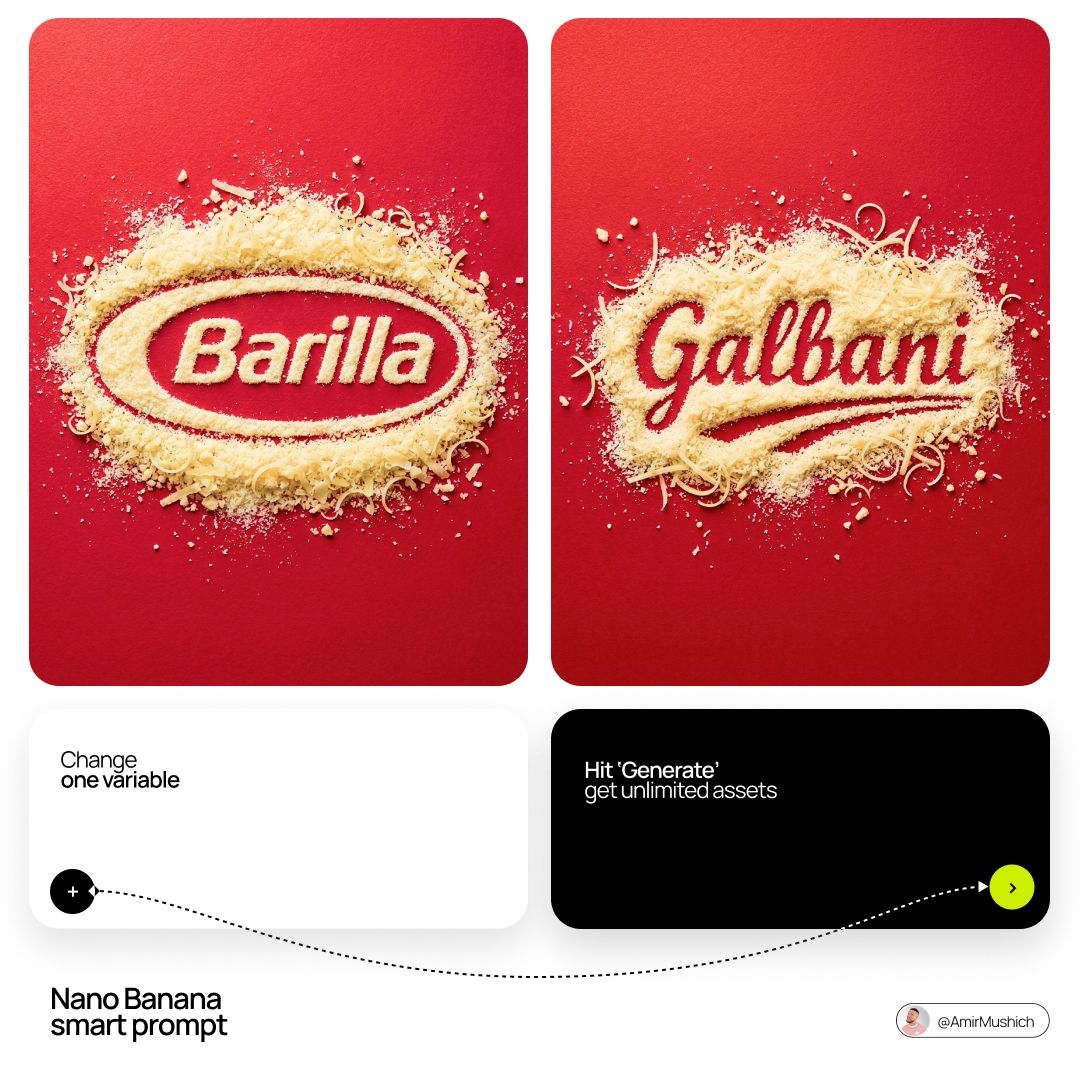
Act as a Food Stylist and Editorial Photographer creating a hero flat-lay food typography image where the brand logo is formed entirely from freshly grated Parmigiano-Reggiano cheese on a bold red surface. References: Foodism magazine editorial photography, Bon Appétit ingredient flat-lay photography, Kinfolk food editorial, professional food styling photography.
---
PHASE 0: BRAND LOGO INTELLIGENCE — CRITICAL
Retrieve the canonical primary mark of [BRAND NAME] from training data. Identify the most iconic reduced form — the single shape most recognizable as [BRAND NAME]. Use the core logo symbol, emblem, or primary letterform exactly as it appears in official brand materials. If [BRAND NAME] is primarily a wordmark — use the single most iconic letter or first letter only.
CRITICAL — CHEESE IS THE LOGO SHAPE, NOT A CUTOUT: the cheese IS the logo — it forms the positive shape of the logo mark. The cheese is piled where the logo has solid form. The red background shows through where the logo has designed empty space or negative areas between strokes. This is NOT cheese with the logo cut out of it. This is NOT a logo-shaped hole in cheese. This is NOT a circular or oval blob of cheese with the logo removed from inside. The cheese accumulation defines the positive strokes and solid forms of the logo — exactly like the letter F in the reference where cheese IS the letter, not a surface with the letter removed from it. If someone removed all the cheese from the image they would see only the red background. The cheese pile IS the logo shape.
POSITIVE FORM RULE — STRICTLY ENFORCED: the cheese pile exists ONLY where the canonical [BRAND NAME] logo has solid positive form. The red background is visible ONLY where the logo has designed negative space. If the logo has three stripes — there are three separate cheese formations in the shape of those stripes. If the logo has a letterform — the cheese forms that letterform. The relationship between cheese and background mirrors exactly the relationship between positive and negative space in the original logo. No exceptions.
---
PHASE 1: BACKGROUND SURFACE
A flat matte surface filling the entire frame. Surface material: thick matte art paper or fine-grain painted board — not glossy, not reflective, not plastic. Fine visible grain — like thick watercolor paper or a matte painted surface. This grain texture is visible at macro distance as a subtle micro-texture. Background color: deep saturated red — #CC1414 to #D42020. The color is completely flat and uniform across the entire frame — no gradients, no vignette, no lighting variation. The red has a slight matte warmth — not neon, not orange-red, a classic deep editorial red.
---
PHASE 2: GRATED PARMIGIANO-REGGIANO — MAXIMUM REALISM CRITICAL
The logo positive form is made entirely of freshly grated Parmigiano-Reggiano cheese. This is the hero material — every detail of the cheese texture must be physically accurate and photographically real.
Physical properties of freshly grated Parmigiano-Reggiano: a mix of particle types present simultaneously — short fine powder-like dust from the hardest zones, small irregular granules 1 to 3mm, medium irregular flakes 3 to 8mm, and occasional longer curling shreds 8 to 15mm that twist slightly as they fall from the grater. Color: off-white to pale cream — #F5F0E0 to #EDE8D0, with some slightly more yellow particles #E8DEBB where the cheese is denser. Individual particles catch the overhead light differently — particles with their flat face upward appear bright near-white, particles on their side appear slightly shadowed and more cream-colored.
Pile construction: the cheese is piled to a physical height of 4 to 8mm within the logo form — enough to create clearly visible soft micro-shadows beneath the pile where it meets the red background. The pile is not uniform — slightly higher and denser along the center axis of each stroke or form element, naturally thinning toward the edges. The pile has genuine three-dimensional volume — a real mound of grated cheese with a slightly rounded top surface. At the very edges of the logo form individual cheese shreds and particles extend beyond the main mass — some long curling shreds breach the logo boundary by 3 to 10mm, small particles scatter 5 to 20mm beyond the edge. This organic fringe is critical for realism.
Surface of the cheese pile: the top surface is an irregular landscape of individual particles at various angles — some standing slightly upright, some lying flat, some partially overlapping others. Individual long shreds visible curling across the surface. The texture is rich, dense, and complex — at 400% zoom every individual particle should be identifiable and distinct.
---
PHASE 3: SCATTERED PARTICLES ONLY — NO PROPS
The image contains only two elements: the grated cheese logo form and the red background surface. No cheese wedge. No broken chunks. No grater. No peppercorns. No additional food props of any kind. Clean, minimal, editorial.
Scattered particles: across the red background surface outside the logo form — sparse individual cheese particles that have naturally fallen during the formation of the logo. Small granules, occasional short shreds, fine dust. More concentrated in a loose radius of 20 to 40mm around the logo boundary, becoming sparser toward the frame edges. Approximately 60 to 100 individual scattered particles across the background. These confirm the physical process of grating and placing the cheese.
---
PHASE 4: LIGHTING — OVERHEAD FOOD PHOTOGRAPHY
Camera position: directly overhead, perfectly perpendicular to the surface — zero angle, zero perspective, pure top-down flat-lay.
Lighting: a single large diffused overhead light source — 120×120cm softbox positioned directly above the scene at 60 to 80cm. Very slight forward offset of 10 to 15° from perfectly overhead — creates short soft micro-shadows beneath the cheese pile confirming its physical presence on the surface. Shadow direction: very slightly away from camera, barely perceptible. Shadow softness: very soft edge, almost fully diffused.
Effect on cheese pile: overhead light catches every individual particle. Upward-facing flat surfaces of particles: near-white bright highlights. Side-facing surfaces: slightly shadowed cream-warm tone. Base of pile where it meets the red surface: soft shadow gradient 2 to 4mm wide — red surface darkens slightly where the cheese pile blocks the overhead light. This base shadow confirms pile height and is critical for realism.
Effect on background: completely uniformly lit — no hot spots, no falloff. Only micro-shadows from cheese particles create any variation.
---
PHASE 5: COMPOSITION & CAMERA
Aspect ratio: 4:5 portrait — editorial magazine format. Logo form centered in frame — positioned at vertical center or very slightly above center. Logo occupies 45 to 60% of total frame height — large, commanding, clearly legible. Generous red background visible on all sides. Camera: directly overhead, zero tilt, zero rotation — the logo silhouette reads as the correct [BRAND NAME] mark from this top-down view. Lens: 85mm equivalent at close focus distance — no distortion. Entire scene in sharp focus. Aperture: f/8 to f/11 — everything sharp simultaneously.
---
PHASE 6: TECH SPECS — MAXIMUM PHOTOREALISM
Render: Houdini particle simulation + Redshift or Mantra, OR photorealistic CGI achieving identical result. This image must be indistinguishable from a real food photography shot.
Cheese geometry: every individual particle of grated cheese is a real geometric object — not a texture map, not a normal map, not instanced flat planes. Each particle has its own 3D geometry: irregular rounded granules, flat irregular flakes with slight curvature, long curling shreds with natural twist. Minimum 50,000 individual cheese particle instances within the logo form. Each particle casts its own micro-shadow on the red surface and on adjacent particles.
Cheese material: physically accurate dairy material shader. Base color: #F2EDD8 to #EDE4C4 with 15% random per-particle color variation. Subsurface scattering: active — light scatters through particles making thin edges slightly translucent. SSS radius: 3 to 5mm, SSS color warm cream #FFE8C0. Roughness: 0.55 to 0.70. Specular: 0.05 to 0.1 — small soft highlights on particles facing the light. No metalness.
Background material: matte paper shader — roughness 0.92, fine displacement grain 0.1mm amplitude, albedo #CC1414, no specularity.
Lighting: one large rectangular area light 120×120cm, overhead with 12° forward tilt, 5500K neutral white. No secondary lights. No HDRI. No colored lights.
Ray tracing: minimum 12 bounces. Subsurface scattering: mandatory on all cheese materials. Micro-shadows: physically accurate from every particle instance. Anti-aliasing: maximum. Sampling: minimum 4096 samples per pixel. No film grain. No post-process color grading. Output feel: the cheese must look so real the viewer can smell it. This image is submitted to Bon Appétit as a real photograph and passes.
---
FINAL CHECK — MANDATORY BEFORE OUTPUT: (1) Is the cheese forming the POSITIVE shape of the [BRAND NAME] logo — not a cutout, not a negative, not a blob with logo removed? If not — wrong, regenerate. (2) Is there any cheese wedge, grater, peppercorns, or food prop other than scattered particles? If yes — wrong, regenerate. (3) Does the logo silhouette match the canonical [BRAND NAME] mark exactly? If not — wrong, regenerate. (4) Is the background uniformly red with no gradients? If not — wrong, regenerate.

![[BRAND]: [Brand Name] prompt preview](https://prompts.pixloop.ai/cdn-cgi/image/width=600,format=auto,quality=80/prompts/assets/prompts/2096207481353425049/0.jpg)
![[Matcha Latte] STYLE & ART DIRECTION: Modern minimalist food advertising aesthetics, Swiss-styl…](https://prompts.pixloop.ai/cdn-cgi/image/width=600,format=auto,quality=80/prompts/assets/prompts/2057779197985378623/0.jpg)
![PHOTO BY [BRAND NAME]® / DESIGN BY [BRAND NAME] DESIGN prompt preview](https://prompts.pixloop.ai/cdn-cgi/image/width=600,format=auto,quality=80/prompts/assets/prompts/2056804648678240743/0.jpg)
