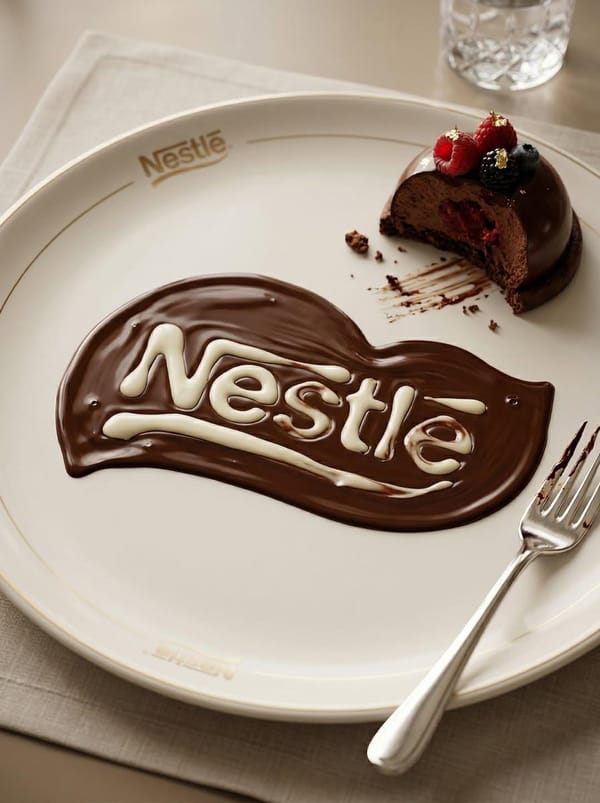
[BRAND NAME]
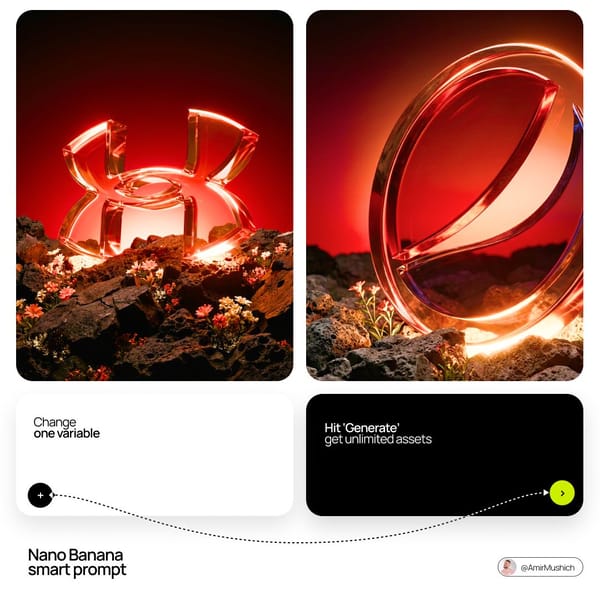
THE MOST IMPORTANT RULE — READ FIRST: The volcanic rock object in this image has the exact silhouette shape of the [BRAND NAME] logo — nothing more, nothing less. The outer boundary of the rock IS the logo outline. The object is NOT a rectangle. NOT a square. NOT a block with straight edges. NOT a slab. The object has NO straight outer edges of its own — every edge follows the canonical [BRAND NAME] logo geometry. If the object is rectangular or square the image is WRONG — regenerate immediately. The logo is NOT carved into, engraved into, or cut into the rock surface. The rock surface is plain volcanic basalt. The rock shape IS the logo.
Background is absolute black #000000 with a single red spot light — no white, no grey, no other colors. If the background is anything other than black with the red spot the image is WRONG.
Act as a CGI Geological Art Director and 3D Type Sculptor creating a hero material study of a brand logo rendered as a massive volcanic rock object — a piece of basalt whose silhouette IS the brand logo shape with a still-molten interior. References: volcanic lava crust texture, basalt geological photography, active volcano lava flow photography.
PHASE 0: BRAND LOGO INTELLIGENCE — GEOLOGICAL TRANSLATION
Retrieve the 100% canonical trademark-accurate primary mark of [BRAND NAME] from training data. Identify the single most iconic reduced form — symbol, monogram, or wordmark. Fidelity test: a brand designer must recognize this as the correct mark.
GEOLOGICAL TRANSLATION RULES — apply in this exact order:
STEP 1 — ESTABLISH EXACT SILHOUETTE: reconstruct the precise canonical [BRAND NAME] mark — every curve, every stroke weight, every proportion exactly as trademarked. Draw this silhouette as a flat solid shape. This is the mold. Every outer edge of the final rock object must follow this silhouette exactly.
STEP 2 — THE ROCK IS THE LOGO SHAPE: the volcanic rock piece has the outer silhouette of the [BRAND NAME] logo. The rock does not contain the logo. The rock does not have the logo on it. The rock IS the logo shape — like cutting the logo from a sheet of volcanic basalt. The outer boundary of the rock traces every curve and line of the canonical logo. Nothing outside the logo silhouette exists as rock. Nothing.
STEP 3 — EXTRUDE INTO THICK SLAB: the logo silhouette is extruded into a thick physical slab — depth equal to 35 to 45% of the logo's total height. Uniform depth throughout. The result is a solid three-dimensional volcanic rock piece whose front face silhouette is exactly the canonical [BRAND NAME] mark.
STEP 4 — GEOLOGICAL DAMAGE TO EDGES ONLY: surface imperfections applied to outer edges and top faces only — fractures, vesicular pitting, cooling cracks. These never alter the core letterform silhouette — they exist only at the very surface. The logo silhouette remains recognizable at all times.
STEP 5 — DUAL MATERIAL: apply the volcanic rock exterior and molten interior from PHASE 2 onto the correctly shaped object.
STEP 6 — BRAND COLOR: autonomously determine the most iconic color associated with [BRAND NAME]. Blend into the molten interior glow. If no dominant color — default to #FF6600.
CRITICAL — ABSOLUTELY FORBIDDEN: (1) No logo carved, engraved, etched, embossed, or cut into the rock surface. (2) No rectangular, square, or straight-edged outer boundary. (3) No logo as a groove or depression in the rock. (4) No white or grey background. The rock surface is plain volcanic basalt. The only logo definition is the outer silhouette of the rock piece itself.
PHASE 1: OBJECT FORM & CONSTRUCTION
The logo mark of [BRAND NAME] is a massive three-dimensional volcanic rock piece — depth approximately 35 to 45% of total letter height. The outer silhouette of this rock piece matches the canonical [BRAND NAME] logo exactly — curved where the logo curves, angular where the logo has angles, with counters and negative spaces of the logo becoming actual holes through the rock where the logo has designed empty space. The front face surface is uniformly rough volcanic basalt with no markings, no engravings, no decorations. Top edges and outer corners carry geological damage — sharp brittle stone fractures along natural stress lines, 4 to 8 irregular breaks. The object floats in black void — no base, no ground, no surface beneath it.
PHASE 2: DUAL MATERIAL SYSTEM — CRITICAL
Outer crust — solidified volcanic rock: exterior surface is solidified basalt. Color: #1A1A1A to #2A2A2A — near-black volcanic basalt with subtle warm undertone where heat bleeds through. Texture: vesicular basalt — large irregular gas bubble voids 3 to 8mm diameter, medium-scale fractured plates, fine crystalline grain, sharp brittle fracture edges. Roughness: 0.88 to 0.95. Crust thickness: 3 to 8mm real geological layer over hot interior. Metalness: 0.0 — pure geological material.
Inner core — molten magma: fully molten incandescent lava beneath the dark crust. Self-luminous — emits light, does not reflect external light. Primary light source of entire scene. Color gradient: deep core #FF6600 to #FF4400, mid-zone #CC3300 to #AA2200, surface breakthrough #FF8800 to #FFAA00, shifted toward brand color from PHASE 0 STEP 6.
Heat breakthrough zones: lower edge — bottom face and bottom edge glow intensely, hottest visible zone. Right face — broad orange-red luminosity across entire right-facing surface. Fracture edges at top — raw interior exposed as bright glowing lines. Thin crust zones — orange-red heat bleeds through as warm subsurface glow, exterior darkens to #3A1A0A. Heat diffusion gradient: 2 to 5mm transition — physically accurate cooling.
PHASE 3: LIGHTING SYSTEM
Primary illumination: molten interior is the sole primary light source on the object — zero external fill lights hitting the object. Lower edge and right face emit strongest light casting warm orange-red glow onto adjacent crust surfaces. Inner faces of letter counters catch internal glow dramatically. Upper surface remains very dark. Object perimeter receives barely perceptible warm orange ambient within 5 to 15mm only.
DRAMATIC TOP-DOWN COLD LIGHT ON FRONT FACE: single narrow focused spot from directly above at 80 to 90° elevation aimed at front face. Cold and harsh — 7000 to 8000K pure white-blue, maximum contrast with warm orange below. Upper portion of front face: cold white-grey raking light reveals every vesicular pit and crystalline grain detail. Lower portion: warm orange-red self-illumination. These zones meet at vertical midline in a sharp dramatic boundary — cold geological surface light against internal volcanic heat. This cold-warm contrast on the front face is the hero lighting moment.
BACKGROUND RED SPOT LIGHT: a single dramatic red spot light projected onto the black background behind the object — color #CC0000 to #FF1A00, positioned slightly offset from center, illuminating a soft circular zone of the background approximately 30 to 40% of frame width in diameter. The spot light does not illuminate the object — it exists only on the background, creating a deep red atmospheric halo behind the volcanic rock piece. The red glow is brightest at its center point, falling off softly toward pure black at its edges. The spot light center is positioned slightly upper-right or lower-right of the object center — asymmetric placement creates compositional tension between the red background glow and the orange-red self-illumination of the object. The red background spot and the orange lava glow from the object bleed into each other at the object perimeter — creating rich warm atmospheric depth around the volcanic piece.
PHASE 4: CAMERA & COMPOSITION
Camera angle: 3/4 view from slightly below — 20 to 30° below the object's horizontal midline, 35 to 45° to the left of frontal. Reveals simultaneously: front face, right side face catching heat glow, bottom edge as brightest zone, top edge with fracture geometry. Object rotated 5 to 10° clockwise tilt — dynamic instability. Object size: 55 to 65% of frame width, centered slightly above vertical center. Background: absolute black #000000 with red spot light — complete void except for the red atmospheric glow. No ground plane, no surface, no shadow beneath object. Aspect ratio: 1:1 square. Depth of field: none — entire object sharp.
PHASE 5: TECH SPECS
Render: Octane Render or Redshift. Outer crust: PBR geological shader, roughness 0.88 to 0.95, multi-layer displacement map with large gas bubble voids + medium fracture plates + fine crystalline grain, albedo #1A1A1A to #2A2A2A, metalness 0.0. Gas bubble voids: real geometric displacement — actual cavities in surface mesh, not normal map. Inner molten: emissive blackbody shader at 1200 to 1600°C shifted toward brand color, emissive intensity 8 to 15. Heat diffusion: subsurface scattering on crust with scatter color matching inner glow. Fracture edges: hard geometry cuts, no smoothing — sharp like broken stone. Background spot light: area light or spot light aimed at background plane only, red #CC0000 to #FF1A00, soft falloff, does not affect object directly. Ray tracing: minimum 16 bounces. Global illumination: on. Anti-aliasing: maximum. Sampling: minimum 2048 samples. No film grain. No post-process. Background: pure black #000000 with red spot only.
FINAL CHECK — MANDATORY BEFORE OUTPUT: (1) Is the background pure black with only the red spot light? If not — wrong, regenerate. (2) Does the outer silhouette of the rock piece match the exact [BRAND NAME] logo shape? If not — wrong, regenerate. (3) Is the object rectangular, square, or block-shaped with straight outer edges? If yes — wrong, regenerate. (4) Is there any logo marking, engraving, or groove on the rock surface? If yes — wrong, regenerate. (5) Are both cold top light and warm self-illumination visible on the front face? If not — wrong, regenerate. (6) Is the red background spot light visible as a separate atmospheric element behind the object? If not — wrong, regenerate.


![[BRAND NAME] | [COLOR] prompt preview](https://prompts.pixloop.ai/cdn-cgi/image/width=600,format=auto,quality=80/prompts/assets/prompts/2048828286466134200/0.jpg)
![[BRAND NAME]: Enter the brand name here. prompt preview](https://prompts.pixloop.ai/cdn-cgi/image/width=600,format=auto,quality=80/prompts/assets/prompts/2033619671522345426/0.jpg)
![[BRAND NAME]. Act as a 3D Product Visualization Artist. prompt preview](https://prompts.pixloop.ai/cdn-cgi/image/width=600,format=auto,quality=80/prompts/assets/prompts/2034709218549199327/0.jpg)